For a CMO in financial services, the right AI move this year is a few small, measured pilots with guardrails in place, not a transformation programme. The board wants an AI story, vendors promise results by next quarter, and teams are already experimenting with a dozen tools.
In a category where trust is the product, the leaders who gain most are not the fastest adopters. They are the ones who know what to try first and what to ignore.
The examples below are illustrative scenarios, not client data. Swap in your own numbers and products.
Where to start
Start where the risk is low and the results are easy to measure.
Start with the work nobody misses. First drafts, resizing, versioning, localisation across languages and markets, and report summaries. These give your team quick wins without putting the brand on the line.
Example: A credit card team needs one cashback offer adapted into English, Hindi and Tamil across email, SMS and app banners. AI produces the first versions in an afternoon, the team edits them, and compliance reviews the final copy.
Start with listening. Call-centre transcripts, app reviews, complaints and relationship-manager notes hold how customers actually talk about fees, onboarding and trust. AI is very good at spotting patterns in them, provided the data is anonymised and approved for use.
Example: Run a month of anonymised call transcripts and app reviews through AI to cluster the complaints. You may find that confusion over joining-fee waivers drives more calls than any product issue, and a rewritten onboarding email can fix that.
Start with one workflow and a baseline. Pick a process with a clear owner, such as adapting a card or wealth campaign across segments. Record how long it takes, what it costs and how long approvals take today, then compare after the pilot. Without a baseline, “AI saved us time” is an opinion.
Example: Take the monthly wealth newsletter for HNI clients. Say it takes six working days from brief to send, with three review rounds. Use AI for the first draft and segment variants, then compare days and rounds after two cycles.
Start by fixing your data. AI is only as good as what you feed it. Customer data, consent records, naming conventions and segment definitions (mass affluent, HNI, UHNI) need to be clean and consistent before you buy anything clever. It is unglamorous work, and it decides whether the rest succeeds.
Example: If “HNI” means a ₹5 crore portfolio in one system and ₹2 crore in another, any AI-led segmentation will contradict itself. Agree one definition and clean up consent flags before the pilot starts.
What to skip
Five traps are worth avoiding, because each one costs time or trust.
The tool-of-the-week chase. New tools launch constantly. Choose problems first, then tools. If you cannot state the problem in one sentence, you are not ready to buy.
Example: A team signs up for separate AI tools for copy, images, video and analytics in one quarter, and nobody can say which problem each one solves. Better: state the problem first (“cut campaign adaptation time”), then pick one tool and test it.
The AI strategy deck with no owner. A strategy without a budget, a metric and a named person accountable is just a presentation.
Example: An “AI-first marketing” deck is approved at an offsite, and six months later nothing has a budget or a metric. Better: the head of marketing operations owns one pilot, with a budget and a monthly turnaround target.
Full automation of customer-facing, regulated communication. Anything that quotes a rate, a return, a fee or an eligibility rule, or makes a claim, needs a human reviewer and compliance sign-off. Speed is not worth a compliance miss or a broken customer relationship.
Example: An AI-generated ad promises “earn up to 8% returns” with no risk disclaimer, or quotes a rate that changed last week. A human reviewer and compliance sign-off catch it before it goes live.
Vanity metrics. “We use AI in 40% of workflows” tells you nothing. Measure outcomes: cycle time, cost per output, conversion and customer satisfaction.
Example: Instead of “AI is used in 40% of workflows”, report “campaign adaptation time fell from five days to two” or “cost per localised asset is down by a third”.
Outsourcing your brand voice to the model. AI scales whatever point of view you give it. If you do not have one, it produces competent, generic content at speed. A useful test: could a competitor have produced this with the same prompt? If yes, you have made content, not a brand asset.
Example: Ask AI for a “trusted, modern, customer-first” wealth tagline and two competitors will get near-identical lines. Better: give the model your voice guidelines, words you never use and copy you love, then have a person choose.
Put guardrails in before you scale
Agree the rules with compliance, legal, risk and information security before the pilots begin, not after. At a minimum, decide:
What customer data may and may not be used in AI tools, and where that data is stored and processed
Example: Anonymised call transcripts in an approved enterprise tool are allowed. Pasting customer names, account numbers or portfolio details into a public chatbot is not.
Which content always needs human review, and which needs compliance approval as well
Example: A festival greeting post needs marketing review. Any post that mentions rates, returns, fees or eligibility also needs compliance approval.
How you will handle disclosure where AI plays a visible role in customer communication
Example: A website chat assistant tells customers they are talking to an automated assistant and offers a route to a human.
Which vendors are approved, and what happens to your workflow if one changes or disappears
Example: Keep an approved-vendor list, a contract clause barring the vendor from training on your data, and a way to export your prompts and templates.
Who is accountable when something goes wrong
Example: Every AI-assisted workflow has a named owner, such as the head of campaigns, who signs off the output and answers for it.
In financial services, trust is the product. These guardrails protect it.
A simple 90-day shape
Three phases keep the effort small enough to learn from and structured enough to scale.
Days 1 to 30: Pick two or three low-risk workflows, record baselines and agree the guardrails with compliance and risk.
Example: Choose campaign adaptation, review-note summaries and customer-feedback tagging. Record today’s turnaround and cost for each, and get the data rules signed off by compliance.
Days 31 to 60: Run the pilots, track results against the baselines and gather honest feedback from the team.
Example: Run each pilot on two live campaigns, with a fortnightly 30-minute review where the team says what saved time and what needed rework.
Days 61 to 90: Scale what worked, stop what did not, and decide explicitly where humans stay in the loop.
Example: Scale campaign adaptation if it cut turnaround without adding compliance rework. Drop feedback tagging if it needed heavy manual correction. Record that all rate-related copy stays human-written.
Questions to ask before you buy any AI tool
What specific problem does this solve, and how will we know it worked?
Example: “Cut campaign adaptation time from five days to two with no rise in compliance rework” can be tested. “Be more innovative” cannot.
What data does it need, where does that data go, and does it leave our environment?
Example: Ask the vendor in writing whether prompts and uploads are stored, who can see them, and whether they are used to train models.
Who owns the output, and who reviews it before it reaches a customer?
Example: The tool drafts, the campaign manager edits, compliance approves, and an audit trail records each step.
What happens to our workflow if the vendor changes terms or disappears?
Example: Ask what happens to your saved templates and prompts if the vendor is acquired or shuts down, and whether you can export them.
The bottom line
A good AI playbook is less about the technology than about discipline. Start small, measure honestly, protect trust and keep your point of view. The CMOs who do that will get compounding returns, while the rest end up with a collection of tools.
Why brand matters more, not less, in the age of AI
Anyone can now generate a logo, a tagline and a brand book in under an hour. So the question I hear more and more is whether brand still matters.
It does, and I’d argue it matters more than it ever has. Here’s why.
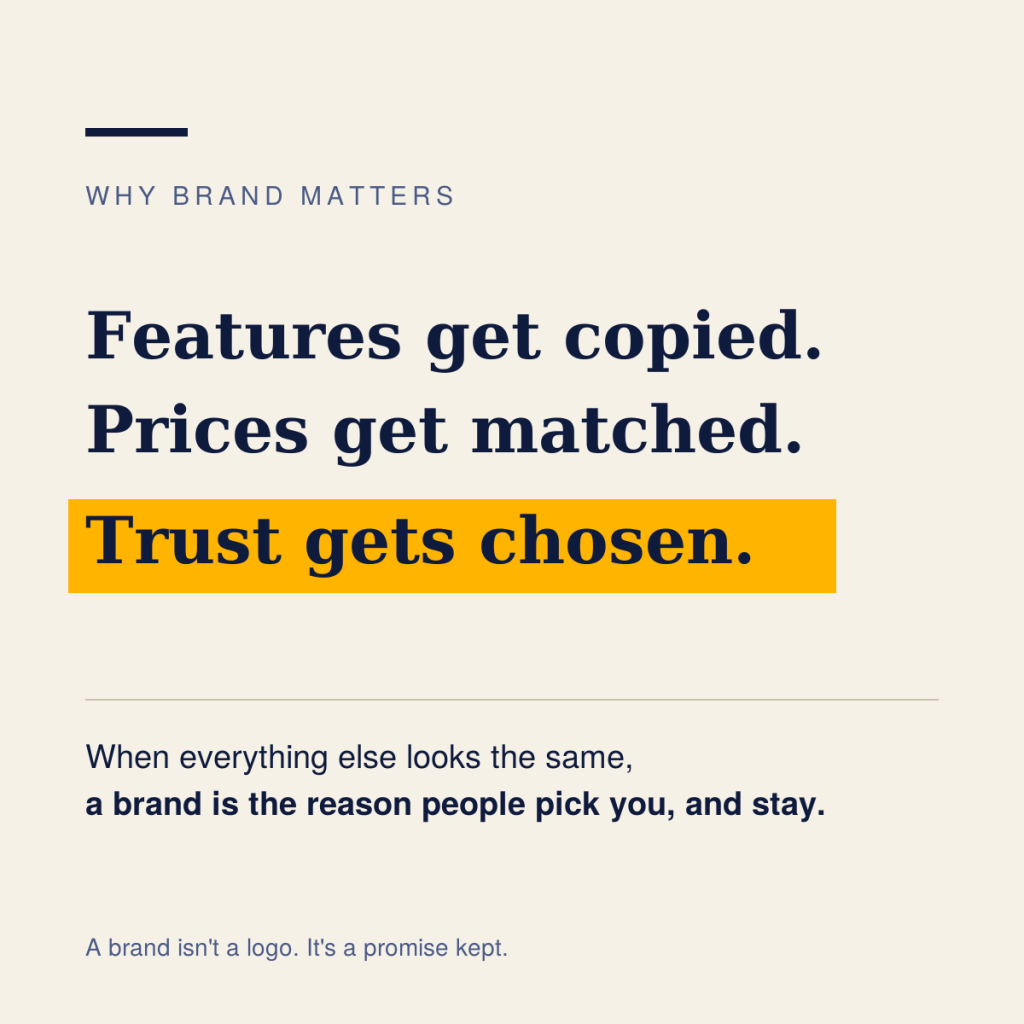
Features get copied
Whatever your product does better today, a competitor will match in a quarter. AI has shortened that cycle further. A feature that once took a rival a year to replicate can now be rebuilt in weeks.
A feature advantage is a head start, and it doesn’t last.
Prices get matched
The same applies to price. A discount is the easiest move to copy and the hardest to take back. Once you compete on price alone, you’ve told customers that price is the only reason to choose you, and someone will always undercut you.
In financial services this is sharper still. The customer isn’t buying a product off a shelf. They’re handing over their savings, their credit and sometimes their family’s future. A cheaper rate rarely wins that decision by itself.
Trust gets chosen
When features look similar and prices are close, people choose the brand they believe. That belief is the real asset, and it doesn’t come from a campaign. It comes from a promise kept again and again: the service call that gets resolved, the fee that’s explained upfront, the 9pm moment when something goes wrong and someone actually helps.
A brand isn’t a logo, and it isn’t a tagline. It’s the accumulated evidence that you do what you say.
Where AI fits in
AI is a superb tool for scaling a brand. It can adapt one idea across formats, languages and segments, and it can draft, test and refine faster than any team could by hand.
But it scales whatever you give it. If you have a clear point of view and a record of keeping your promises, AI amplifies both. If you don’t, it produces polished, generic content at speed.
Anyone can generate a brand book in an hour. Nobody can generate a track record.
A question worth asking
If your brand is a list of features, a price point and a good-looking identity, ask yourself what would make a customer stay when a competitor copies all three.
The answer is your brand. If you can’t state it clearly, that’s where the work is.
The bottom line: features, prices and visuals are all easy to copy. Trust is the one thing that has to be earned, which is why it’s the one that holds.
Brand marketing and performance marketing are not rivals; they are two halves of one growth system, and most companies get into trouble when they fund one and starve the other.
Yet the argument never seems to end. In one meeting, the CFO wants every rupee tied to a conversion. In the next, the CMO is defending a film, a sponsorship or a rebrand whose payoff will not show up in this quarter’s dashboard. Agencies pick sides, platforms sell the side that feeds their own ad products, and the founder in the corner wonders why customer acquisition cost keeps climbing even though the performance team is hitting every target.
This post tries to settle the argument properly. We will define what each discipline really does, look at where each one breaks, understand why the measurement tools we rely on tilt the table, and then build a practical way to decide how much of each your business needs. If you only remember one thing, make it this: performance marketing harvests demand, and brand marketing creates it. A business that only harvests will eventually run out of field.
What brand marketing actually does
Brand marketing makes a business easy to remember, easy to choose and worth paying more for. Its job is to build memory structures in the minds of people who are not buying today, so that when a need arises, your name is among the first that come to mind. Researchers call this mental availability, and it is the quiet engine behind most category leaders.
In practice, brand work covers a wide set of activities: positioning, naming, visual and verbal identity, mass-reach advertising, sponsorships, content with a point of view, public relations, employer brand and the consistency of every customer touchpoint. What ties them together is that they work on the many, not the few. A good brand campaign reaches people who will never click on it, and that is precisely the point.
Brand marketing does three things that no amount of bid optimisation can replicate:
It lowers the cost of every future sale. A known, trusted name converts more of the traffic it gets, from search, from referrals and from sales conversations.
It supports pricing power. People pay more, and switch less, for brands they feel they understand and trust.
It compounds. A distinctive asset such as a colour, a sound, a character or a line, built consistently over years, keeps earning long after the media spend behind it has ended.
The weakness of brand marketing is just as real. It is slow, it is hard to attribute to a single sale, and it is easy to hide mediocre work behind the phrase “building awareness”. A brand investment with no clear idea, no distinctive asset and no way to check whether it moved anything is not strategy; it is expense.
What performance marketing actually does
Performance marketing turns existing intent into measurable action, and you pay for outcomes you can count. Search ads, social lead generation, affiliates, app-install campaigns, retargeting, marketplace ads and email or WhatsApp nurture flows all sit here. The common thread is a trackable path from spend to a click, a sign-up, a lead or a sale.
Its strengths are easy to admire. You can start small, learn in days, switch off what fails and scale what works. Budgets can be tied to cost per acquisition, return on ad spend or payback period, which makes the conversation with finance far simpler. For a young business with little brand recognition, performance channels are often the fastest route to the first thousand customers.
But performance marketing has a ceiling, and it is set by demand that already exists:
It can only reach people who are already looking. Search converts the person typing the query; it does not create the person who types it.
It gets more expensive as you scale. Once the best audiences are exhausted, each additional customer costs more than the last, because you are bidding against competitors for the same finite pool.
It rents attention. Stop paying and the traffic stops. Nothing accumulates on your balance sheet.
It rewards what is measurable over what matters. Teams drift towards the cheap, ready-to-buy customer and away from the larger, harder-to-reach audience that drives long-term growth.
A useful way to hold both ideas in mind is the farm. Performance marketing is the harvest: efficient, countable, essential. Brand marketing is the soil and the seed. Harvest hard for long enough without replanting and the yield falls, and the dashboard will blame the harvesters.
Side by side: how the two disciplines differ
The cleanest way to see the difference is to compare them on the questions a leadership team actually argues about.
Search, social lead ads, affiliates, retargeting, email, app ads
Primary metrics
Awareness, consideration, brand preference, share of search, price premium
Clicks, leads, cost per acquisition, return on ad spend, conversion rate
Effect on cost
Lowers future acquisition cost and raises margin
Delivers volume at today’s market price
Main risk
Spending without a clear idea or proof
Over-reliance on a shrinking pool of ready buyers
Where it lives in the P&L
Often treated as a cost, but builds an asset
Treated as a variable cost of sales
Two patterns are worth noticing. First, the two disciplines answer different questions, so judging one by the other’s metric is unfair to both. A film will lose to a search campaign on cost per click every time, just as a search campaign will lose to a film on reach among non-buyers. Second, they often sit in different teams with different budgets, different agencies and different incentives. That separation is where most of the trouble starts.
The measurement trap
Performance marketing looks more effective than it is because the tools that measure it were built to flatter it. Last-click and platform-reported attribution give full credit to the final touchpoint before a purchase, and the final touchpoint is very often a branded search, a retargeting ad or an email to someone who had already decided.
Consider a typical customer journey. A person sees a memorable film, hears a friend praise the product, reads a review, and a week later types your brand name into a search bar and clicks the first ad. The dashboard records one conversion, credited to search, at a very attractive cost. Everything that made that person search for you by name is invisible to the report.
This creates a quiet, self-reinforcing loop:
Performance channels report strong returns because they capture people already primed to buy.
Budgets shift towards those channels, and brand spend is cut as “unproven”.
Over the following quarters, the pool of primed buyers shrinks, because nothing is refilling it.
Cost per acquisition rises, and the response is usually to optimise performance harder rather than question the mix.
The lesson is not that performance data is wrong. It is that attribution answers “who got the credit?” and not “what caused the sale?”. Teams that want the real answer need tools that look beyond the click: incrementality tests with holdout groups, geo experiments, marketing mix modelling, and simple tracking of brand health and branded search volume over time. None of these is perfect, but together they correct for the bias built into the click.
The flywheel: how brand and performance feed each other
The two disciplines work best when each makes the other cheaper to run. Brand activity warms the audience, so performance ads get higher click-through and conversion rates. Performance activity captures that warmed demand, produces data about who converts and why, and feeds the next round of brand messaging.
You can see the effect in everyday numbers. When a brand campaign is running well, branded search volume tends to rise, retargeting audiences grow, and the same landing page converts a larger share of visitors. When brand spend stops, the reverse happens slowly: the funnel gets thinner, and the performance team has to pay more to find each buyer.
The handoff between the two is where the best marketers put their attention:
Creative continuity. The performance ad should feel like it belongs to the same brand as the film. Consistent look, voice and promise help people recognise you at the moment of action.
Shared audiences. Brand reach can be used to seed retargeting and lookalike pools, so the audience you paid to reach is not lost after one exposure.
Shared learning. Performance data shows which messages convert and which objections come up. That insight should shape the next brand brief, not sit in a separate report.
Shared goals. If brand and performance teams are measured on different, conflicting numbers, they will optimise against each other.
Think of it as a single funnel rather than two budgets. Brand fills the top and keeps the whole funnel wider; performance makes sure that what falls into it is converted efficiently.
What the evidence says
The most cited body of research on this question comes from Les Binet and Peter Field, who studied hundreds of effectiveness case studies from the UK’s IPA awards. Their central finding, published as The Long and the Short of It, is that campaigns built to create long-term brand effects produced larger and more durable business results than campaigns built only for short-term response, and that the most effective marketers did both.
From this work comes the famous 60/40 rule of thumb: roughly 60 per cent of budget on brand building and 40 per cent on activation. It deserves care. The ratio is an approximate average across many categories, not a law, and it has been refined in later work.
The split tends to shift towards activation in categories with short purchase cycles, small customer pools or strong existing demand, and towards brand in large consumer categories with many occasional buyers.
Young or small brands often need to lean more on activation to survive long enough to build anything.
Brand effects are slower to appear, but once they do they tend to show up as lower price sensitivity and steadier growth, not just a one-off spike.
A second strand of thinking, associated with Byron Sharp and the Ehrenberg-Bass Institute, argues that growth mostly comes from reaching many light buyers and being easy to notice and easy to buy, rather than from deepening loyalty among a few. That supports the case for broad-reach brand work alongside efficient conversion.
The practical reading is simple. Nobody has proved a single ideal ratio for every business, but the direction of the evidence is consistent: businesses that invest only for the short term tend to plateau, and businesses that invest only in brand without a way to convert it leave money on the table. If you want a starting hypothesis, begin near the middle and let your own incrementality tests move it.
A closer look: financial services and other high-trust categories
In categories where the customer is handing over money, data or long-term commitment, brand does the heavy lifting that performance cannot. Think of a credit card, a wealth management relationship, a loan, an insurance policy or an investment platform. Nobody clicks an ad and entrusts their savings to a name they have never heard of.
In these categories the funnel has a few distinctive features:
Trust is the real product. Rates and features are often similar across competitors. The deciding factor is whether the customer believes the institution will be there, will be fair and will handle problems well.
Consideration is long. A prospective wealth client may research for months, speak to peers and compare several firms before ever filling a form. Performance marketing sees only the last few minutes of that journey.
The cost of a bad lead is high. Regulated onboarding, verification and sales effort make a low-quality lead expensive, so cheap clicks can be a false economy.
Lifetime value is large. A premium customer who stays for a decade justifies investment in reputation, content and relationships well beyond what the first-year margin would suggest.
This is why leading banks and fintechs pair a steady brand narrative (credibility, expertise, a clear point of view on money) with tightly managed performance programmes for lead generation, card applications and app activation. The brand work makes the lead cheaper and the conversation shorter; the performance work makes sure no warm prospect slips away.
For newer fintech brands, the temptation is the opposite: grow fast on paid channels, then discover that acquisition costs rise sharply once the early adopters are gone. The remedy is not to abandon performance, but to start investing in distinctive, trust-building brand assets earlier than feels comfortable.
Common mistakes on both sides
Both camps have their own ways of going wrong, and each is easy to recognise once named.
Mistakes brand teams make
Running campaigns with no distinctive asset, so the audience remembers the ad but not the advertiser.
Changing the creative, tagline or positioning every year, which resets the memory they paid to build.
Refusing to define what success looks like, then defending spend with vague claims about awareness.
Ignoring the conversion path, so interest created by the campaign lands on a slow, confusing website.
Mistakes performance teams make
Treating last-click revenue as proof of causation and cutting anything that does not show up in it.
Over-investing in branded search and retargeting, which mostly collect sales that would have happened anyway.
Chasing the lowest cost per lead and ending up with customers who churn, default or never activate.
Running creative that looks nothing like the brand, which wastes the recognition brand spend has built.
Mistakes leadership makes
Cutting brand budgets first when times are tough, because the damage is slow and invisible, then wondering why recovery takes longer.
Splitting the teams so completely that they have different agencies, different goals and no shared view of the customer.
Judging brand by a quarterly return and performance by a long-term one, or the other way around, instead of using the right clock for each.
A practical framework for balancing the two
The right mix depends on where your business is and what it sells, so start from four questions and let the answers set your first hypothesis.
How well known are we among people who could buy? Low awareness means performance is fishing in a small pond, and brand investment has the most room to help.
How long is the buying journey? The longer and more considered the purchase, the more brand matters in the stages performance cannot see.
How much of our performance spend is capturing people who already know us? If most of it is branded search and retargeting, your real acquisition engine is thinner than the dashboard suggests.
Are we growing efficiently, or are we paying more each quarter for the same result? Rising acquisition cost with a flat conversion rate is the classic sign that the funnel needs refilling.
The table below turns those answers into a starting point by business stage. The weightings are directional hypotheses to test, not prescriptions.
Stage
Leaning
Why
What to watch
Early-stage or new brand
Mostly performance, with a thin layer of brand basics
Cash is tight and you need proof of demand quickly
Payback period, but also a clear name, look and promise from day one
Scaling brand
Balanced, shifting towards brand as paid costs rise
Cheap audiences are being used up
Cost per acquisition trend, branded search volume
Established leader
Brand-led, with disciplined performance to convert
Growth now depends on reaching new and light buyers
Brand preference, penetration, price premium
Challenger in a crowded category
Brand for distinctiveness, performance for conversion
You need to be noticed and chosen over bigger rivals
Share of search against competitors, conversion rate
Three habits make any split work better:
Plan the two together. One calendar, one customer view and one shared target, such as new customers at a given blended cost, rather than separate wish-lists.
Fund brand on a longer clock. Commit to a multi-year view and judge it with leading indicators such as awareness, consideration and share of search, rather than monthly sales.
Test before you cut. Before reducing either side, run a holdout or a regional experiment. Evidence settles budget arguments faster than opinion.
Metrics that matter, on each side and together
Good measurement uses a different clock for each discipline and a shared scoreboard above both. A dashboard that mixes them without labels tends to make the faster clock win.
Layer
What to track
What it tells you
Brand health
Unaided and aided awareness, consideration, preference, net promoter score
Whether the audience’s memory and attitude are moving
Brand demand
Branded search volume, share of search against competitors, direct traffic
Whether interest is growing in the real world
Brand economics
Price premium, win rate in competitive deals, customer retention
Whether the brand is earning more per sale
Performance efficiency
Cost per acquisition, return on ad spend, conversion rate, payback period
Whether paid channels are converting well today
Incrementality
Holdout and geo-test lift, marketing mix model contribution
Which spend actually caused sales, not just got credit
Shared outcomes
New customers, blended acquisition cost, customer lifetime value, revenue growth
Whether the whole system is working
A few rules keep the scoreboard honest:
Prefer blended numbers for the top-line view. Total marketing spend divided by total new customers shows the real cost of growth and cannot be gamed by shifting credit between channels.
Watch trends, not snapshots. One month of branded search tells you little; twelve months tells you whether the brand is working.
Pair every efficiency metric with a quality metric. Cost per lead should always sit beside lead-to-customer conversion and early retention.
Be honest about what cannot be measured. Some brand effects are real but diffuse. A sensible team accepts a reasonable range of evidence rather than demanding false precision.
The bottom line
The real choice is not brand or performance but how to sequence and balance them so that each makes the other work harder. Performance marketing gives you speed, accountability and a direct line from spend to sales. Brand marketing gives you reach, trust, pricing power and a lower cost for every sale that follows.
If you take a few things away from this post, let them be these:
Performance captures demand that already exists; brand creates new demand and makes capture cheaper.
Attribution rewards the last click, so judge channels with incrementality tests, not platform reports alone.
The right balance depends on your stage, your category and the length of your buying journey, and the evidence points to doing both.
In high-trust, high-consideration categories such as financial services, brand is not a luxury; it is part of the product.
Run brand and performance as one system, with shared goals, shared creative direction and shared learning.
The next time the room splits into two camps, try changing the question. Instead of asking which one deserves the budget, ask which constraint is limiting growth right now: not enough people who know us, or not enough of the people who know us converting. The answer will tell you where the next rupee should go.
Further reading: Les Binet and Peter Field, The Long and the Short of It (IPA, 2013); Byron Sharp, How Brands Grow (Oxford University Press, 2010).
Most content doesn’t fail because it’s bad. It fails because nobody has time to look at what’s working.
Digital marketers spend hours pulling reports from Google Ads, Meta and LinkedIn and far less time acting on them. By the time the insight arrives, the campaign has moved on. Markifact is built to close that gap.
What Markifact does
Markifact is a no-code marketing automation platform. You design AI-driven workflows on a visual drag-and-drop canvas, start them with triggers (a schedule, an event or a manual click), and connect them to the tools you already use. It integrates with Google Analytics, Meta Ads and LinkedIn, plus AI providers such as OpenAI and Claude.
Five ways to optimize content with it
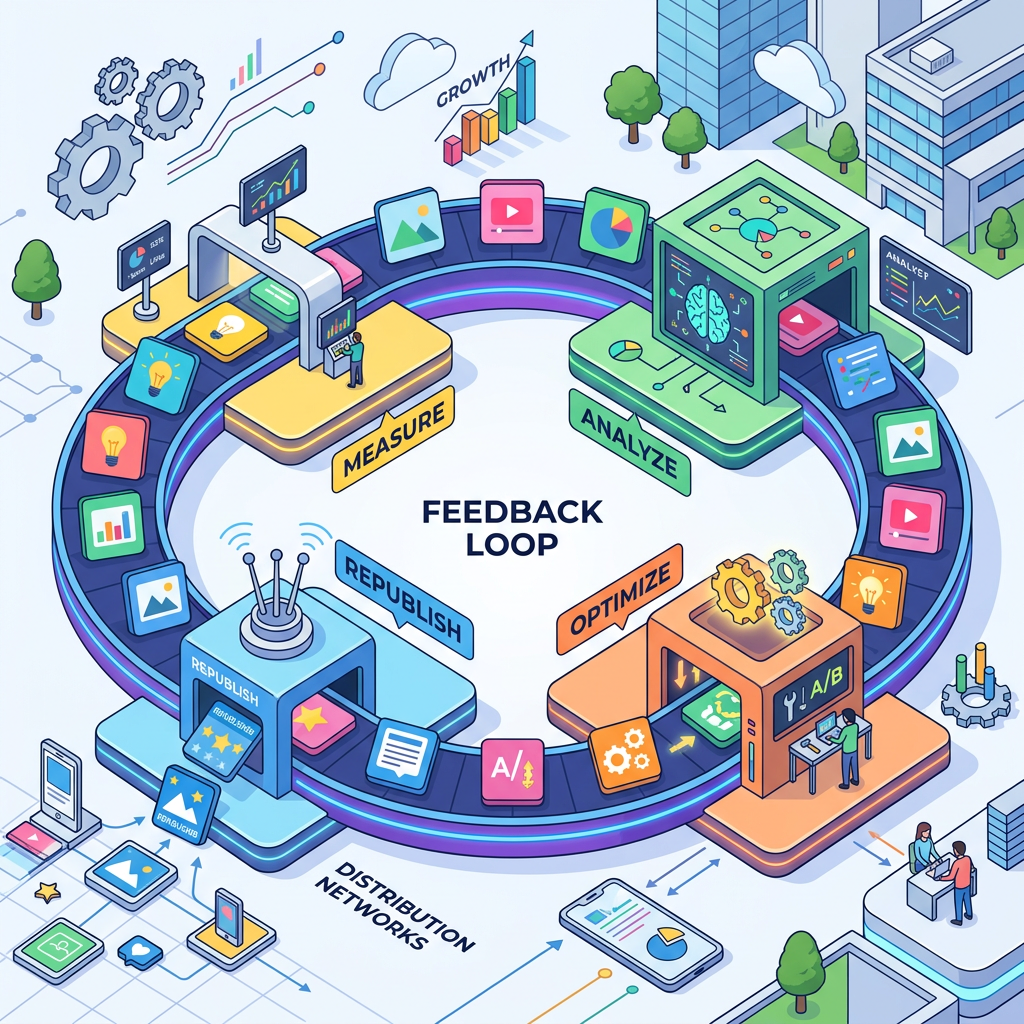
1. Automate the performance read-out. Build a weekly workflow that pulls creative-level results from your ad platforms and posts a summary to Slack. You stop hunting for data and start discussing it.
2. Add an AI analysis step. AI analysis nodes can sit inside a workflow and create decision paths that determine the next action. Use one to flag which headlines, hooks and formats are pulling ahead, and which are fatiguing.
3. Feed winners back into creative. Markifact also supports ad creative generation. Take the patterns from your best performers and brief new variants against them, instead of starting from a blank page.
4. Start from templates. The platform includes pre-built templates for social media, email campaigns and lead nurturing. Adapt one rather than building from scratch.
5. Keep a human in the loop. Automation tells you what is happening. Deciding what it means for the brand is still your job. Treat the AI as a sharp analyst, not the CMO.
The real shift
The goal is to move from reporting on content to running a continuous optimization loop: measure, learn, create, repeat, with far less manual effort.
Where to start
Don’t automate everything at once. Pick one report you build manually every week, automate it, and see how much time it gives back. Then layer in the analysis and creative steps.
Are you automating parts of your content optimization already?