• Best Practices for AEO: How to Get Your Brand Chosen as the Answer

    A growing share of searches no longer ends in a click. A customer asks a question, an AI assistant or a search results page gives an answer, and the journey is over before anyone visits a website.

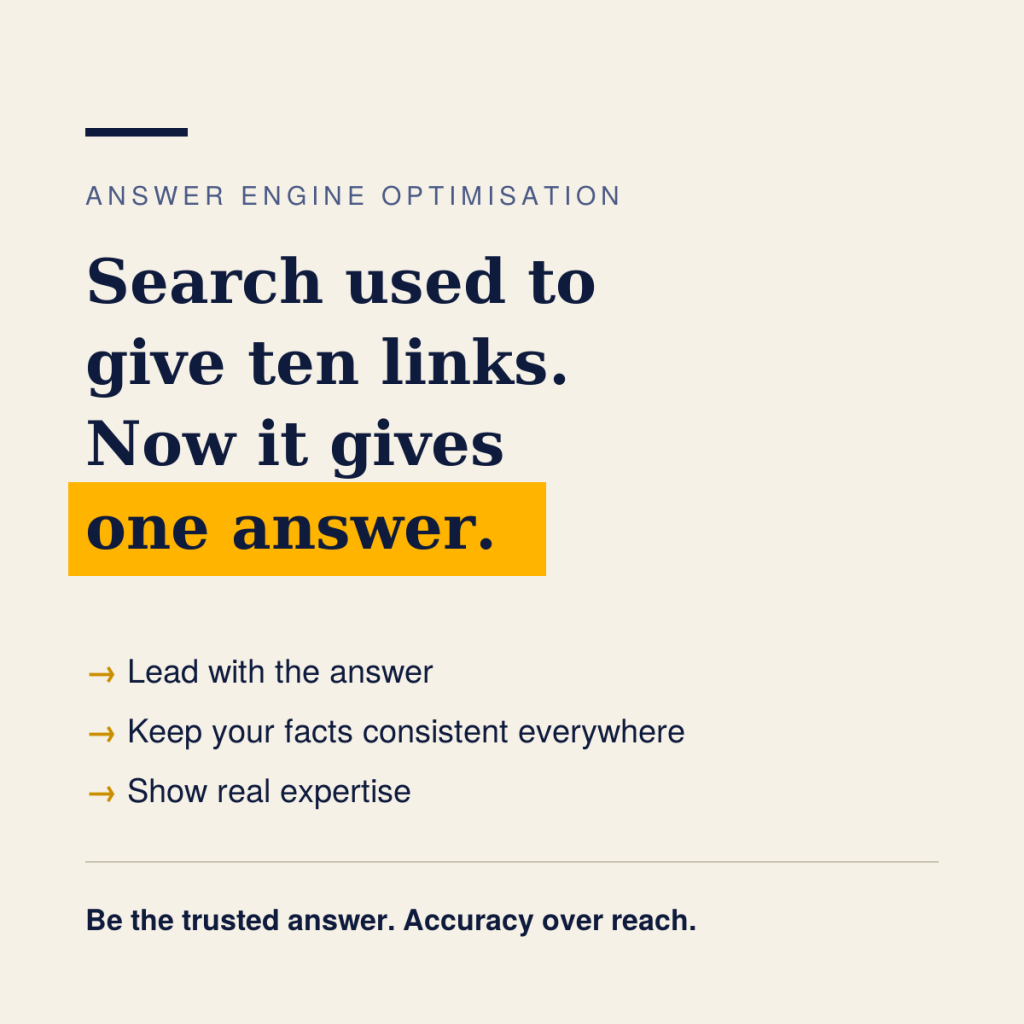
    That changes what marketers compete for. The goal used to be a place on the list of ten blue links. Increasingly it is a place inside the answer itself: the source that is cited, the brand that is named, the product that is recommended.

    That is what answer engine optimisation, or AEO, is about. This article sets out what it is, the practices that matter most, how to measure it and what regulated sectors need to watch.

    What AEO is, and how it differs from SEO

    Answer engine optimisation is the practice of making specific parts of your content, such as a definition, a comparison, a recommendation or a statistic, usable as the answer that search engines and AI tools deliver (CXL). The unit that matters is often the individual answer, not the whole page.

    It builds on SEO rather than replacing it. A solid SEO foundation is usually a prerequisite.

    SEOAEO
    GoalRank pages and earn clicksSupply the answer, even when no click follows
    Where it shows upSearch results pagesFeatured snippets, voice responses, AI-generated answers
    Typical queriesKeywordsConversational, question-led queries
    Common metricsRankings, organic traffic, click-through rateCitations, brand mentions, share of voice, assisted conversions

    Why it matters now: Pew Research data, as reported by CXL, found that clicks on traditional results fell from 15% to 8% when an AI summary appeared (July 2025). Treat any single study as directional, but the trend is clear. More answers are delivered without a visit.

    You will also see the term GEO, or generative engine optimisation, used for much the same work. The labels matter less than the practices.

    Best practices

    Start with an honest caveat. Google says there are no additional requirements to appear in AI Overviews or AI Mode, and no special optimisations necessary beyond its standard guidance (Google Search Central). So AEO is mostly about doing the fundamentals well and making your expertise easy to quote. The practices below follow that principle, and the examples are illustrative.

    1. Get the SEO basics right. Pages must be crawlable, indexed and eligible to show with a snippet. Keep important content in text, link pages together internally and give readers a good page experience. Google lists these as its own recommendations.
      • Example: A customer-education page whose key explanations sit inside images or a PDF is hard to quote. Put the same explanation in plain text on the page.
    2. Lead with the answer. Use a question as the heading and answer it directly underneath, in roughly 40 to 60 words, then add detail. Place key answers early on the page. In CXL’s analysis of 100 AI Overview citations, 55% came from the first 30% of the page. That is a small sample, so treat it as direction, not a rule.
      • Example: Under “Will my EMI change if interest rates change?”, give a two-sentence plain-language answer first, then explain fixed and floating rates, reset dates and the borrower’s options below it.
    3. Build content around real customer questions. Mine support tickets, sales calls and forums for the words customers actually use, and cover likely follow-up questions on the same page (HubSpot).
      • Example: Call-centre logs show customers asking why a fee was charged. A page that answers exactly that, in their words, is more quotable than a general fees overview.
    4. Keep your facts consistent everywhere. Names, products, pricing, differentiators and key terms should match across your site, listings, profiles and app stores. A central source-of-truth document helps (HubSpot).
      • Example: If your website, your app listing and a partner page quote three different processing fees for the same home loan, an answer engine has no reliable fact to repeat.
    5. Use structured data honestly. Make sure markup matches the visible text on the page. Types such as FAQ, Organization, Product and Article are common, but Google says no special schema is needed to appear in its AI features, and CXL cautions that schema is not a switch for AI citation.
      • Example: Add FAQ markup only to a page that genuinely carries those questions and answers, not to every page on the site.
    6. Show expertise and earn third-party trust. Credentials, named expert authors, reviews, reputable mentions and authoritative links all feed the authority signals that CXL groups under E-E-A-T.
      • Example: Put named authors with credentials on customer-education pages, and seek citations from reputable financial publications.
    7. Support text with other formats. Google recommends high-quality images and video alongside text. HubSpot suggests transcripts, answer-oriented chapter markers and the core explanation early in a video.
      • Example: An explainer video on how a home loan EMI is calculated, with a transcript on the page and the core answer in the first minute.
    8. Keep content accurate and current. CXL lists accuracy and freshness among the basics. Review pages whenever rates, fees or rules change.
      • Example: Review rate and fee pages monthly, and show a last-updated date.

    What AEO means in regulated sectors

    In banking, securities and insurance, being quoted is only useful if you are quoted correctly. Answer engines can lift a sentence out of its context, and a rate or a return without its conditions can mislead.

    • Put conditions next to claims. Keep disclaimers, eligibility rules and risk statements in the same passage as the number they qualify, so they travel together.
    • Own your facts page. Maintain one accurate, current page for each product’s key terms, fees and rates, and make it the source every other page and listing matches.
    • Check what the engines say about you. Test your priority questions regularly and look for wrong rates, outdated terms or confused products. Correct the source content first, then use the platforms’ feedback routes where they exist.
    • Keep compliance in the loop. Any content built to be quoted, especially anything about yields, returns or eligibility, needs the same review as an advertisement.
    • Prefer accuracy to reach. A narrower, correct answer builds the trust that regulated brands depend on. A wider, wrong one does the opposite.

    How to measure AEO

    Clicks tell only part of the story. Google’s John Mueller has argued that people who click through from AI answers are likely to be more engaged, as summarised by Practical Ecommerce. Treat that as Google’s claim and test it against your own conversion data.

    Track a short list of metrics against a fixed set of priority questions, and repeat the test every month.

    MetricWhat it tells youHow to track it
    Citation frequencyHow often your pages are cited as a source for your priority questionsAsk the questions manually across Google, AI assistants and voice, or use a tracking tool
    Brand mentions in answersWhether you are named, even without a linkThe same manual tests, logged in a simple sheet
    Impressions versus clicks on question queriesWhere you are visible but answers are absorbing the clickSearch Console, filtered to question-style queries
    AI referral trafficVisits arriving from AI assistantsYour web analytics, by referral source
    Branded search growthWhether visibility in answers is building awarenessSearch Console and trends data
    Assisted conversions and lead qualityWhether AI-influenced visitors become customersCRM and analytics, with a “how did you hear about us” field on forms

    CXL reports that Google added dedicated generative AI reporting to Search Console in June 2026, so check what your own account now shows.

    Common mistakes to avoid

    • Treating AEO as a hack. Google says you do not need special AI files, markup or schema to appear in its AI features. Anyone selling a secret trick is selling something else.
    • Adding FAQ sections everywhere. CXL advises adding FAQs only where they answer real follow-up questions. Padding pages with invented ones adds noise.
    • Writing thin answers with no expertise behind them. A tidy 50-word answer with no named author, evidence or depth is easy to ignore.
    • Letting facts drift. Inconsistent rates, names and terms across channels make you hard to quote and easy to misquote.
    • Measuring only clicks. If answers absorb the click, a falling click count can hide rising visibility. Track citations and mentions too.
    • Chasing every platform. The fundamentals work across most answer engines. Fix those before tuning for any one of them.

    A 30-60-90 day plan

    1. Days 1 to 30: Baseline and fix the basics. List the 25 to 50 questions your customers ask most. Test them across Google, AI assistants and voice, and record who is cited and what is said about you. Fix crawl and indexing problems, and audit your key facts for consistency.
    2. Days 31 to 60: Rework the pages that matter. Rewrite your ten most important pages to lead with the answer. Add FAQs drawn from real questions, add markup that matches the visible text, name expert authors, and bring your listings into line with your facts page.
    3. Days 61 to 90: Extend and measure. Add transcripts and explainer video for the top questions, seek reputable third-party mentions, and re-run the question tests. Report on citations, mentions and assisted leads, then decide what to scale.

    The bottom line

    AEO is not a new trick. It is the older discipline of being genuinely useful, applied to a world in which answers are delivered before clicks. Make your expertise easy to find, easy to quote and consistent everywhere, and check regularly that what the engines say about you is true.

    For regulated brands the priority is simple: accuracy over reach. Being the trusted answer is worth far more than being the most frequent one.

    Sources

  • Why Brand Identity Matters in Marketing Today

    Most brands don’t have a consistency problem. They have a “who made this?” problem.

    One team uses a deep navy, another a bright teal. The sales deck uses one font, the campaign page another. Each piece looks fine on its own. Side by side, they tell the customer nothing about who you are.

    Brand identity fixes that, and for marketers it matters more today than it ever has. Anyone can now produce polished content in minutes. When producing is easy, being recognisable is what’s hard.

    What brand identity is, and what it isn’t

    Brand identity is the set of things a customer can see, read and feel that make your brand recognisable: your name, logo, colours, typography, imagery, tone of voice and the way they all fit together.

    It is not the same as your brand. The brand is what people believe about you. The identity is how you show up so they can recognise you and, over time, form that belief. A strong identity cannot rescue a weak product, but a weak identity wastes a strong one.

    It is also not decoration. A logo is a signature, not a strategy. The real value of identity is that it makes your choices repeatable: the same colours, the same voice and the same standards, whoever happens to be making the work.

    Why it matters for marketers

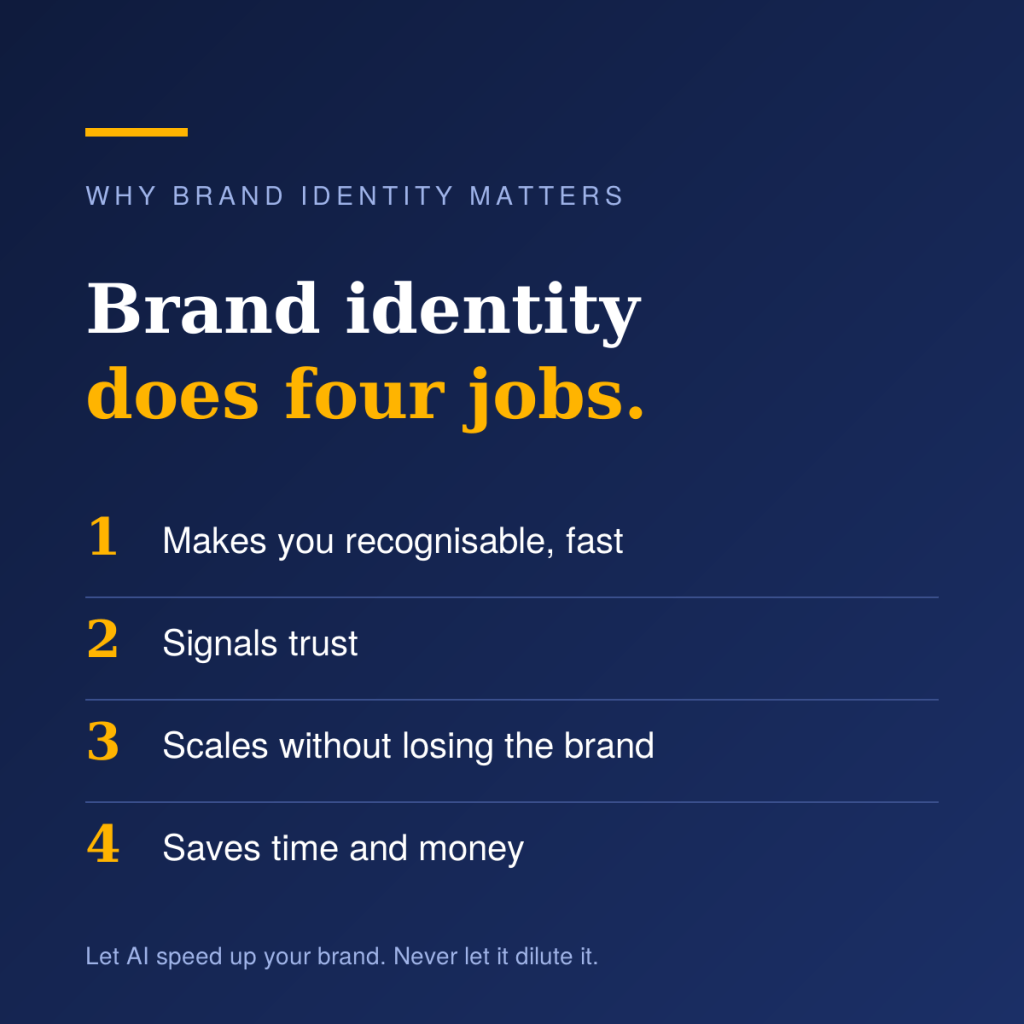
    For a marketer, a clear identity does four jobs.

    1. It makes you recognisable fast. In a crowded feed or inbox, people decide in a second or two whether to keep looking. A consistent look and voice means they recognise you before they have read a word.
      • Example: A bank whose campaigns always use the same colour, typeface and tone of voice is recognised across email, app and outdoor, even with the logo hidden.
    2. It signals trust. Inconsistency reads as carelessness, and carelessness is expensive in categories where customers hand over their money. Consistent, tidy work suggests a business that pays attention to details.
      • Example: A wealth brand’s statements, emails and website all look and sound alike. A customer who spots a mismatched, off-brand email is more likely to wonder whether it is genuine.
    3. It lets teams scale without losing the brand. The more people, agencies and tools produce your work, the more the brand drifts. A clear identity gives everyone the same starting point.
      • Example: Five regional teams and two agencies each build a festive campaign. With shared rules, the results feel like one brand. Without them, they feel like seven.
    4. It saves time and money. When colours, fonts, layouts and tone are decided once, nobody reinvents them for each project, and approvals go faster because reviewers are checking against a standard.
      • Example: A product launch page that starts from approved components takes days to review. One built from scratch triggers a round of debate about the basics.

    Why AI raises the stakes

    AI has made content cheap, and that changes where the value sits. When anyone can generate a deck, a banner or a page in minutes, the volume of polished-looking work goes up and the ability to stand out goes down.

    AI also defaults to the average. A model that doesn’t know your brand will give you a competent, generic version of it, in a palette and tone that a competitor could just as easily have received. Speed then works against you: you can produce off-brand work faster than ever.

    That is why identity has to travel with the work. The brand book that lives in a 90-page PDF nobody opens was always a weak safeguard. In an AI-assisted workflow, it is no safeguard at all, because the tool never saw it.

    Using Claude Design to put identity to work

    The practical fix is to record your identity once, in a form the tool can use, and build from it every time. In Claude, that is a design system: a record of your colours, typography, spacing and components that decks, designs and pages can then be built from.

    A simple way to start:

    1. Write down the basics. Your colours with their exact values, your fonts, your tone of voice and a short “never do this” list. Even a one-page version is enough to begin.
    2. Record them as a design system. Capture the colours, type, spacing and components in one place, so they sit alongside the work instead of in a separate PDF.
    3. Build from it. Create your next deck, campaign page or poster from the design system, rather than starting from a blank canvas each time.
    4. Review and refine. Check the first few outputs against your standards, note what drifted, and tighten the design system. It improves with each round.
    5. Edit and share. Designs made this way can be edited by your team directly and shared or exported, so the identity carries through to whoever picks the work up next.

    The point is not that the tool has taste. The point is that your taste, once written down, gets applied consistently every time.

    What to put in your design system

    Start with these six elements. The examples are placeholders to swap for your own.

    ElementWhat to defineExample (illustrative)
    ColourPrimary, secondary and accent colours with exact values, plus where each is usedDeep navy for backgrounds, amber only for the one thing you want noticed
    TypographyHeadline and body fonts, sizes and weightsA serif headline with a clean sans-serif body
    Layout and spacingMargins, grid, and how much white space to leaveGenerous margins, one idea per slide
    ImageryStyle of photos and illustrations, and what to avoidReal customers and everyday moments, no generic handshake stock photos
    Tone of voiceHow you sound, with words you use and words you never usePlain, warm and direct. Never “synergy” or “world-class”
    ComponentsReusable pieces such as buttons, cards, quote blocks and disclaimersA standard quote card and a standard risk-disclaimer footer

    Keep humans in the loop

    A design system keeps work on brand. It does not make work correct. Someone still has to check the message.

    In regulated sectors such as banking, wealth and insurance, anything that quotes a rate, a return, a fee or an eligibility rule should be reviewed by a person and approved by compliance before it goes out, however good it looks. Build the disclaimer into your components so it is always there, and keep a named owner for each piece of work.

    Also keep the design system itself under human control. Review it every quarter, retire what no longer fits, and make one person responsible for approving changes.

    The bottom line

    Brand identity is how a customer recognises you in two seconds and starts to trust you in twenty. In a world where anyone can produce polished content, it is one of the few things a competitor cannot generate for you.

    Write it down, record it where your tools can use it, and build from it every time. Let AI speed up your brand, and make sure it never dilutes it.

  • The CMO’s AI Playbook: Where to Start, What to Skip

    For a CMO in financial services, the right AI move this year is a few small, measured pilots with guardrails in place, not a transformation programme. The board wants an AI story, vendors promise results by next quarter, and teams are already experimenting with a dozen tools.

    In a category where trust is the product, the leaders who gain most are not the fastest adopters. They are the ones who know what to try first and what to ignore.

    The examples below are illustrative scenarios, not client data. Swap in your own numbers and products.

    Where to start

    Start where the risk is low and the results are easy to measure.

    1. Start with the work nobody misses. First drafts, resizing, versioning, localisation across languages and markets, and report summaries. These give your team quick wins without putting the brand on the line.
      • Example: A credit card team needs one cashback offer adapted into English, Hindi and Tamil across email, SMS and app banners. AI produces the first versions in an afternoon, the team edits them, and compliance reviews the final copy.
    2. Start with listening. Call-centre transcripts, app reviews, complaints and relationship-manager notes hold how customers actually talk about fees, onboarding and trust. AI is very good at spotting patterns in them, provided the data is anonymised and approved for use.
      • Example: Run a month of anonymised call transcripts and app reviews through AI to cluster the complaints. You may find that confusion over joining-fee waivers drives more calls than any product issue, and a rewritten onboarding email can fix that.
    3. Start with one workflow and a baseline. Pick a process with a clear owner, such as adapting a card or wealth campaign across segments. Record how long it takes, what it costs and how long approvals take today, then compare after the pilot. Without a baseline, “AI saved us time” is an opinion.
      • Example: Take the monthly wealth newsletter for HNI clients. Say it takes six working days from brief to send, with three review rounds. Use AI for the first draft and segment variants, then compare days and rounds after two cycles.
    4. Start by fixing your data. AI is only as good as what you feed it. Customer data, consent records, naming conventions and segment definitions (mass affluent, HNI, UHNI) need to be clean and consistent before you buy anything clever. It is unglamorous work, and it decides whether the rest succeeds.
      • Example: If “HNI” means a ₹5 crore portfolio in one system and ₹2 crore in another, any AI-led segmentation will contradict itself. Agree one definition and clean up consent flags before the pilot starts.

    What to skip

    Five traps are worth avoiding, because each one costs time or trust.

    1. The tool-of-the-week chase. New tools launch constantly. Choose problems first, then tools. If you cannot state the problem in one sentence, you are not ready to buy.
      • Example: A team signs up for separate AI tools for copy, images, video and analytics in one quarter, and nobody can say which problem each one solves. Better: state the problem first (“cut campaign adaptation time”), then pick one tool and test it.
    2. The AI strategy deck with no owner. A strategy without a budget, a metric and a named person accountable is just a presentation.
      • Example: An “AI-first marketing” deck is approved at an offsite, and six months later nothing has a budget or a metric. Better: the head of marketing operations owns one pilot, with a budget and a monthly turnaround target.
    3. Full automation of customer-facing, regulated communication. Anything that quotes a rate, a return, a fee or an eligibility rule, or makes a claim, needs a human reviewer and compliance sign-off. Speed is not worth a compliance miss or a broken customer relationship.
      • Example: An AI-generated ad promises “earn up to 8% returns” with no risk disclaimer, or quotes a rate that changed last week. A human reviewer and compliance sign-off catch it before it goes live.
    4. Vanity metrics. “We use AI in 40% of workflows” tells you nothing. Measure outcomes: cycle time, cost per output, conversion and customer satisfaction.
      • Example: Instead of “AI is used in 40% of workflows”, report “campaign adaptation time fell from five days to two” or “cost per localised asset is down by a third”.
    5. Outsourcing your brand voice to the model. AI scales whatever point of view you give it. If you do not have one, it produces competent, generic content at speed. A useful test: could a competitor have produced this with the same prompt? If yes, you have made content, not a brand asset.
      • Example: Ask AI for a “trusted, modern, customer-first” wealth tagline and two competitors will get near-identical lines. Better: give the model your voice guidelines, words you never use and copy you love, then have a person choose.

    Put guardrails in before you scale

    Agree the rules with compliance, legal, risk and information security before the pilots begin, not after. At a minimum, decide:

    • What customer data may and may not be used in AI tools, and where that data is stored and processed
      • Example: Anonymised call transcripts in an approved enterprise tool are allowed. Pasting customer names, account numbers or portfolio details into a public chatbot is not.
    • Which content always needs human review, and which needs compliance approval as well
      • Example: A festival greeting post needs marketing review. Any post that mentions rates, returns, fees or eligibility also needs compliance approval.
    • How you will handle disclosure where AI plays a visible role in customer communication
      • Example: A website chat assistant tells customers they are talking to an automated assistant and offers a route to a human.
    • Which vendors are approved, and what happens to your workflow if one changes or disappears
      • Example: Keep an approved-vendor list, a contract clause barring the vendor from training on your data, and a way to export your prompts and templates.
    • Who is accountable when something goes wrong
      • Example: Every AI-assisted workflow has a named owner, such as the head of campaigns, who signs off the output and answers for it.

    In financial services, trust is the product. These guardrails protect it.

    A simple 90-day shape

    Three phases keep the effort small enough to learn from and structured enough to scale.

    1. Days 1 to 30: Pick two or three low-risk workflows, record baselines and agree the guardrails with compliance and risk.
      • Example: Choose campaign adaptation, review-note summaries and customer-feedback tagging. Record today’s turnaround and cost for each, and get the data rules signed off by compliance.
    2. Days 31 to 60: Run the pilots, track results against the baselines and gather honest feedback from the team.
      • Example: Run each pilot on two live campaigns, with a fortnightly 30-minute review where the team says what saved time and what needed rework.
    3. Days 61 to 90: Scale what worked, stop what did not, and decide explicitly where humans stay in the loop.
      • Example: Scale campaign adaptation if it cut turnaround without adding compliance rework. Drop feedback tagging if it needed heavy manual correction. Record that all rate-related copy stays human-written.

    Questions to ask before you buy any AI tool

    • What specific problem does this solve, and how will we know it worked?
      • Example: “Cut campaign adaptation time from five days to two with no rise in compliance rework” can be tested. “Be more innovative” cannot.
    • What data does it need, where does that data go, and does it leave our environment?
      • Example: Ask the vendor in writing whether prompts and uploads are stored, who can see them, and whether they are used to train models.
    • Who owns the output, and who reviews it before it reaches a customer?
      • Example: The tool drafts, the campaign manager edits, compliance approves, and an audit trail records each step.
    • What happens to our workflow if the vendor changes terms or disappears?
      • Example: Ask what happens to your saved templates and prompts if the vendor is acquired or shuts down, and whether you can export them.

    The bottom line

    A good AI playbook is less about the technology than about discipline. Start small, measure honestly, protect trust and keep your point of view. The CMOs who do that will get compounding returns, while the rest end up with a collection of tools.

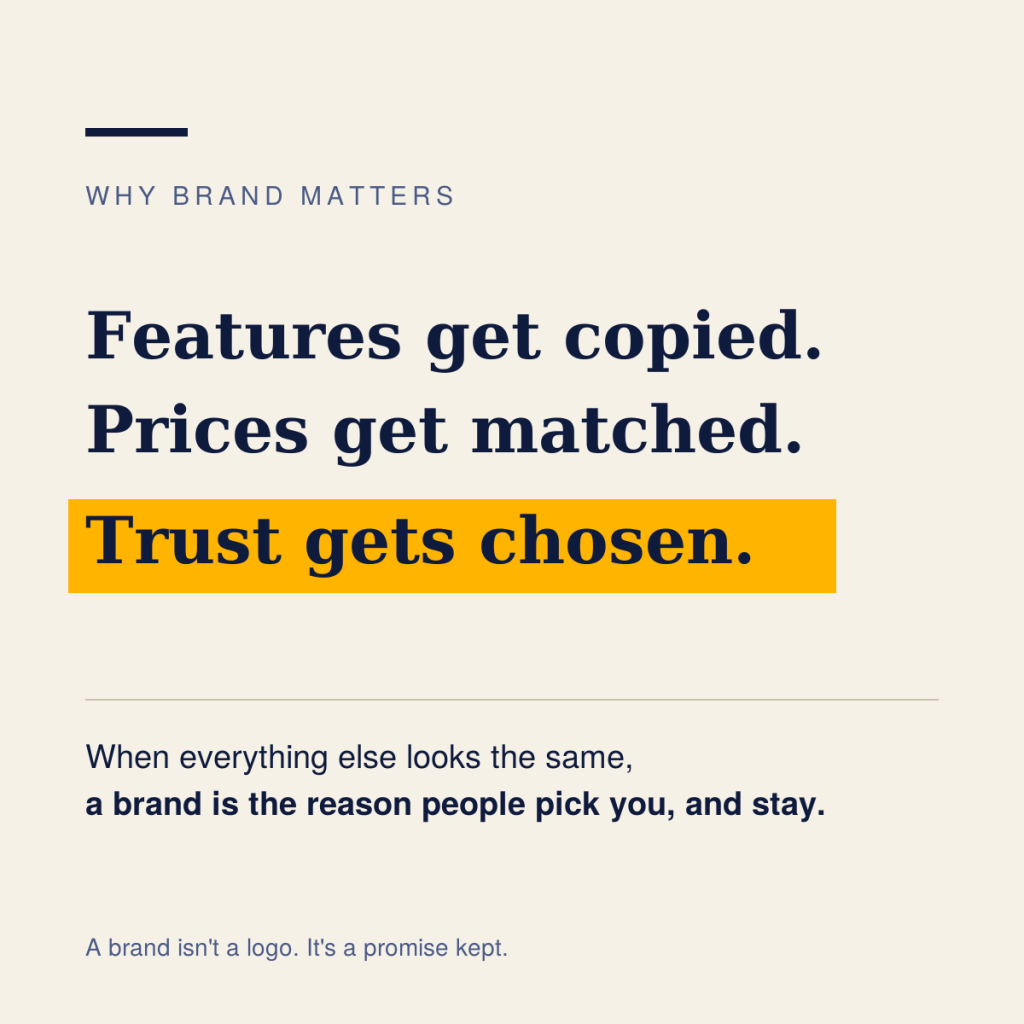
  • Features Get Copied. Prices Get Matched. Trust Gets Chosen.

    Why brand matters more, not less, in the age of AI

    Anyone can now generate a logo, a tagline and a brand book in under an hour. So the question I hear more and more is whether brand still matters.

    It does, and I’d argue it matters more than it ever has. Here’s why.

    Features get copied

    Whatever your product does better today, a competitor will match in a quarter. AI has shortened that cycle further. A feature that once took a rival a year to replicate can now be rebuilt in weeks.

    A feature advantage is a head start, and it doesn’t last.

    Prices get matched

    The same applies to price. A discount is the easiest move to copy and the hardest to take back. Once you compete on price alone, you’ve told customers that price is the only reason to choose you, and someone will always undercut you.

    In financial services this is sharper still. The customer isn’t buying a product off a shelf. They’re handing over their savings, their credit and sometimes their family’s future. A cheaper rate rarely wins that decision by itself.

    Trust gets chosen

    When features look similar and prices are close, people choose the brand they believe. That belief is the real asset, and it doesn’t come from a campaign. It comes from a promise kept again and again: the service call that gets resolved, the fee that’s explained upfront, the 9pm moment when something goes wrong and someone actually helps.

    A brand isn’t a logo, and it isn’t a tagline. It’s the accumulated evidence that you do what you say.

    Where AI fits in

    AI is a superb tool for scaling a brand. It can adapt one idea across formats, languages and segments, and it can draft, test and refine faster than any team could by hand.

    But it scales whatever you give it. If you have a clear point of view and a record of keeping your promises, AI amplifies both. If you don’t, it produces polished, generic content at speed.

    Anyone can generate a brand book in an hour. Nobody can generate a track record.

    A question worth asking

    If your brand is a list of features, a price point and a good-looking identity, ask yourself what would make a customer stay when a competitor copies all three.

    The answer is your brand. If you can’t state it clearly, that’s where the work is.

    The bottom line: features, prices and visuals are all easy to copy. Trust is the one thing that has to be earned, which is why it’s the one that holds.

Create your own website, free on WordPress.com.Create your own website.
Start free