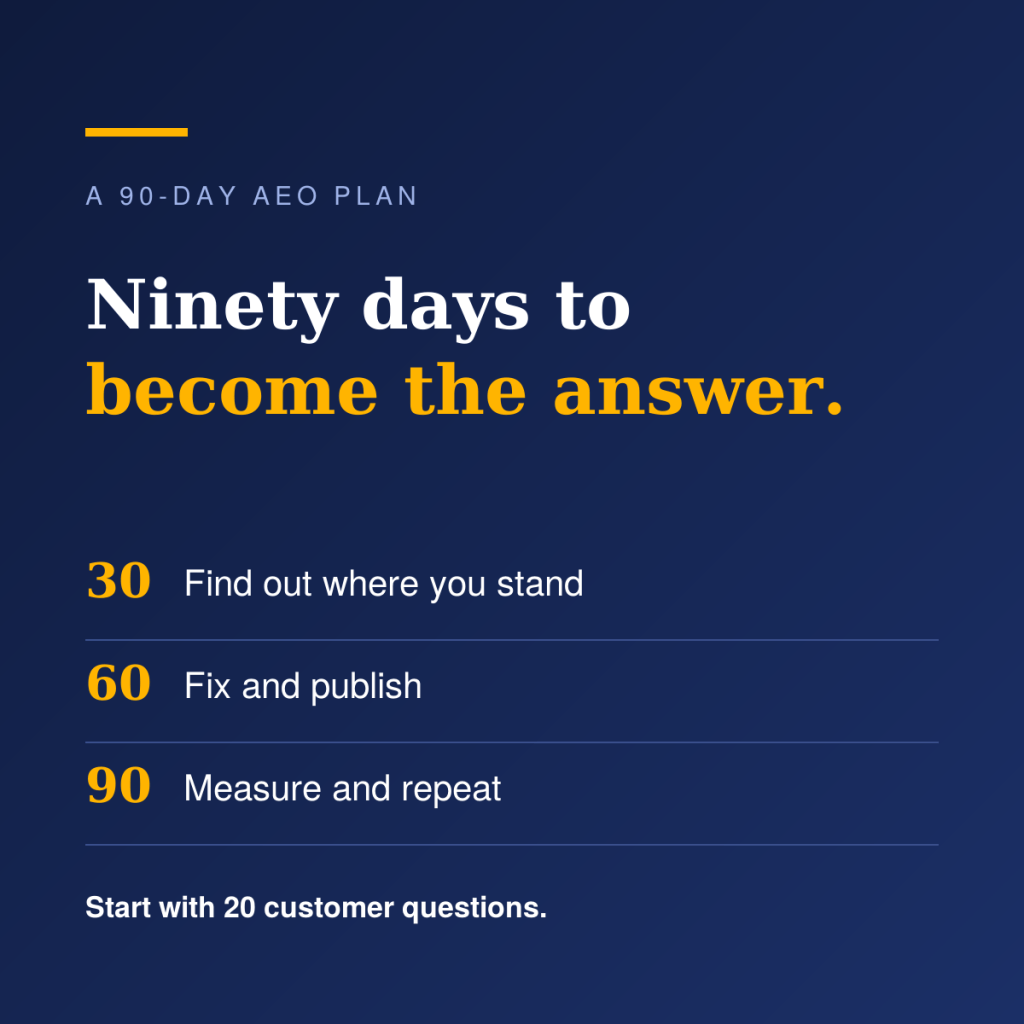
A 90-day plan turns answer engine optimisation (AEO) from a vague worry into three phases: find out where you stand, fix what is wrong and publish what is missing, then measure and repeat. It needs no new budget, only an owner, a list of customer questions and the discipline to check the results.
The reason to plan is that AEO is not a one-off fix. You are trying to become a source that AI answers can draw on, and that depends on many small things being right at the same time: clear pages, consistent facts, visible expertise and a reputation outside your own site. Doing one of them well does little. Doing all of them over a quarter starts to show.
This post sets out the plan, a week-by-week schedule, how to measure it, and what to watch for in financial services. Where the evidence is thin, which is often, I say so.
What is known, and what is guesswork
Google’s own guidance is the firmest ground, and it is plainer than most AEO advice. For its AI Overviews and AI Mode, Google tells site owners to:
- create original content with a unique point of view and first-hand expertise, and “don’t just recycle what others on the internet have already said”;
- keep content people-first, clearly structured, and technically crawlable and indexable;
- keep business and product data current in Merchant Center and Google Business Profile;
- measure with the Generative AI performance report in Search Console.
Google also lists what it says you do not need: new machine-readable or AI-specific files, special markup, rewriting content into tiny chunks, or special phrasing. It says structured data is not required for generative AI search, that an llms.txt file neither helps nor harms visibility in Google Search, and that “no third-party tool has access to our internal ranking or AI systems” (Google Search Central). An earlier Google post made the same point that clicks from AI Overviews tend to be higher quality, and that success should be judged on outcomes such as sales and sign-ups, not only clicks (Search Engine Journal, May 2025).
That covers Google. ChatGPT, Perplexity, Gemini and others choose sources in ways they have not published. Most “AEO checklists” mix Google’s advice with practitioner opinion. One widely read playbook, for example, recommends a 40 to 80 word opening answer, set refresh schedules and a 30/60/90-day plan, but none of that is backed by cited data (ALM Corp). I use that kind of advice below as a sensible working method, not as proven rules.
So the plan rests on one idea. The things most likely to help are the things that make you the best, clearest and most consistent source on your topic. If a tactic only makes sense as a trick, skip it.
Days 1-30: find out where you stand
The plans below are my working method, built on Google’s guidance and common practice. They are not a standard. Use home loans as the running example: swap in your own product.
The first month is about evidence. Do not rewrite anything until you know what is wrong.
- Name an owner and pick one topic cluster. AEO touches content, product, compliance and web. One person needs to hold it together. Start with a single cluster, such as home loans, not the whole site.
- Build the question list. Collect 20 questions real customers ask before choosing: eligibility, rates, fees, documents, how long approval takes, how you compare with a bank or another lender. Use sales and service call notes, search queries, and your own site’s search box.
- Run the baseline. Ask each question in the AI tools your customers use (ChatGPT, Gemini, Perplexity, Google’s AI answers). Record for each: whether you appear, how you are described, who is cited, and what is wrong. Run each question more than once, since answers vary.
- Audit your facts. Check that rates, fees, eligibility rules and product names are identical across your website, app store listings, partner pages, social profiles and directories. Every mismatch is a risk, because a model may pick the wrong version.
- Check the technical basics. Pages must be crawlable, indexable and fast, and nothing important should sit behind a login or a script that blocks reading. Google says a page must be indexed and eligible to show a snippet to appear in its AI features (Google Search Central).
Output of the month: a scorecard with your 20 questions, how you appear on each, and a ranked list of fixes.
Days 31-60: fix and publish
The second month turns the scorecard into changes. Fix the inconsistencies first, then fill the gaps.
- Lead with the answer. On each priority page, put a direct, plain-language answer near the top, then the detail. For “how long does home loan approval take?”, say it in the first lines, with the conditions that change it. Write in short paragraphs that each cover one idea.
- Say something original. Google’s advice is to avoid recycling what is already online. Add what only you know: your real approval process, your own data on how long things take, how a customer’s situation changes the answer.
- Show who is behind it. Add a named author or reviewer, their credentials, and a last-reviewed date. Make substantive updates, not cosmetic date changes.
- Close the gaps. Publish clear pages for the questions your baseline showed you missing on. Keep each one focused on a single question or decision.
- Use the same words everywhere. Pick the primary name for each product and term, and use it consistently, adding alternatives only as plain synonyms.
- Build credibility off your site. Contribute expert commentary, publish original research or data where you have it, and make sure reputable third parties describe you accurately. Google says seeking inauthentic mentions is not helpful, so this is about earning coverage, not manufacturing it (Google Search Central).
- Keep business data current. Update Google Business Profile and any product feeds you use.
You do not need to add special markup for AI answers. Google says structured data is not required for its generative AI features. Standard markup that matches what is visible on the page is still fine for other reasons.
Output of the month: revised priority pages, new pages for the gaps, and one fact sheet of approved product details that everyone in the company uses.
Days 61-90: measure and repeat
The third month shows what moved and sets the habit that keeps it moving.
- Re-run the baseline. Ask the same 20 questions, the same way, in the same tools. Compare with day 1: did you appear more often, was the description correct, who else was cited?
- Read the Search Console report. Google points site owners to the Generative AI performance report in Search Console (Google Search Central). Check which pages show up and for which queries.
- Look at the business outcome. Compare leads, applications and branded search for the optimised cluster against a similar cluster you did not touch.
- Keep what worked, fix what did not. Pages that earned citations show you the pattern. Pages that did not need a clearer answer, better proof or a fix to a conflicting fact elsewhere.
- Extend to the next cluster and set a rhythm. Make the question check a monthly habit and review the fact sheet every quarter.
Output of the month: a before-and-after report, a decision on the next cluster, and a standing monthly review.
The plan at a glance
[embed: node/c3d05eaf-6c78]
Each phase has one output and one gate. Do not start the next phase until the gate is met, because fixes made on top of an unmeasured baseline cannot be judged. Assign one person to own the plan, and name a reviewer from compliance for the gates in months two and three.
How to measure when clicks are not the whole story
An AI answer can shape a decision without sending a visit, so clicks alone understate the effect. Google’s own advice is to judge success on outcomes such as sales and sign-ups, not only clicks (Search Engine Journal). A practical set, adapted from a common four-layer approach (ALM Corp), is:
- Presence. How often you appear for your 20 questions, how you are described and who appears alongside you. Track it by hand each month, or with a tool if you use one, remembering that answers vary from run to run.
- Search signals. Impressions and queries for the optimised cluster in Search Console, including the Generative AI performance report Google points to, plus the trend in branded search.
- Referral behaviour. Visits that arrive from AI tools, which pages they land on, and whether they convert differently from other traffic.
- Business outcome. Qualified leads and applications for the optimised cluster compared with a similar cluster you left alone.
Two cautions. First, tools that promise an “AEO score” are working without access to the platforms’ systems, as Google itself points out, so treat any score as an indicator you cannot audit. Second, with one quarter of data and a small question set, you are looking for direction, not proof. Keep the question list fixed so the comparison stays fair.
Considerations for BFSI and fintech
In financial services a wrong answer is not just a missed click. A model that quotes an outdated rate, the wrong eligibility rule or a fee you no longer charge creates a customer expectation you then have to meet or correct. Four habits help:
- Make one fact sheet the single source of truth. Rates, fees, eligibility, documents and timelines, with an owner and a review date. Every page, listing and partner profile draws from it.
- Date everything that can change. A visible last-reviewed date and a clear statement of what the figures apply to give both readers and machines a way to tell current from stale.
- Put compliance in the workflow. Have compliance review answer-first pages once, then use approved wording and disclosures as templates, so you can publish quickly without reopening each claim.
- Monitor for wrong answers, not just missing ones. When your baseline finds an AI answer that misstates your product, log it, fix the conflicting source if there is one, and report it through the platform’s feedback route where one exists.
Be cautious about promising returns or outcomes in answer-style content. Read your regulator’s advertising rules and each platform’s policies for financial content before publishing at scale. I have not reviewed them for this post.
Common mistakes
- Chasing hacks. Google says you do not need new files, special markup, tiny content chunks or special phrasing, and that an llms.txt file does not affect Google Search. Spend the time on the content instead (Google Search Central).
- Mass-producing pages. Google calls churning out pages to manipulate rankings or AI responses scaled content abuse. A few strong pages beat hundreds of thin ones.
- Rewriting without a baseline. If you do not record where you started, you cannot tell what worked.
- Fixing the site and ignoring everything else. Conflicting facts on partner pages, listings and old PDFs can undo the work.
- Treating it as a project with an end date. Answers and sources keep changing. The monthly question check is the part that lasts.
The takeaway
AEO is not a new trick to learn. It is the old discipline of being the clearest, most accurate and most credible source on your topic, applied in a way you can check. Ninety days is enough to find out where you stand, fix what is wrong and see whether it moved. Start with one cluster, one owner and 20 questions. The brands that do this early will have the habit in place when the rules harden.
Sources
- Google Search Central: optimising for generative AI search: Google’s own guidance on AI Overviews and AI Mode. The main source for what is and is not needed.
- Search Engine Journal: Google’s advice on AI Overviews and AI Mode: May 2025 report on Google’s blog post by John Mueller.
- ALM Corp: Answer engine optimisation in 2026: practitioner playbook; its numbers (answer length, refresh cadence, 30/60/90 plan) are the author’s opinion, with no cited data.

