
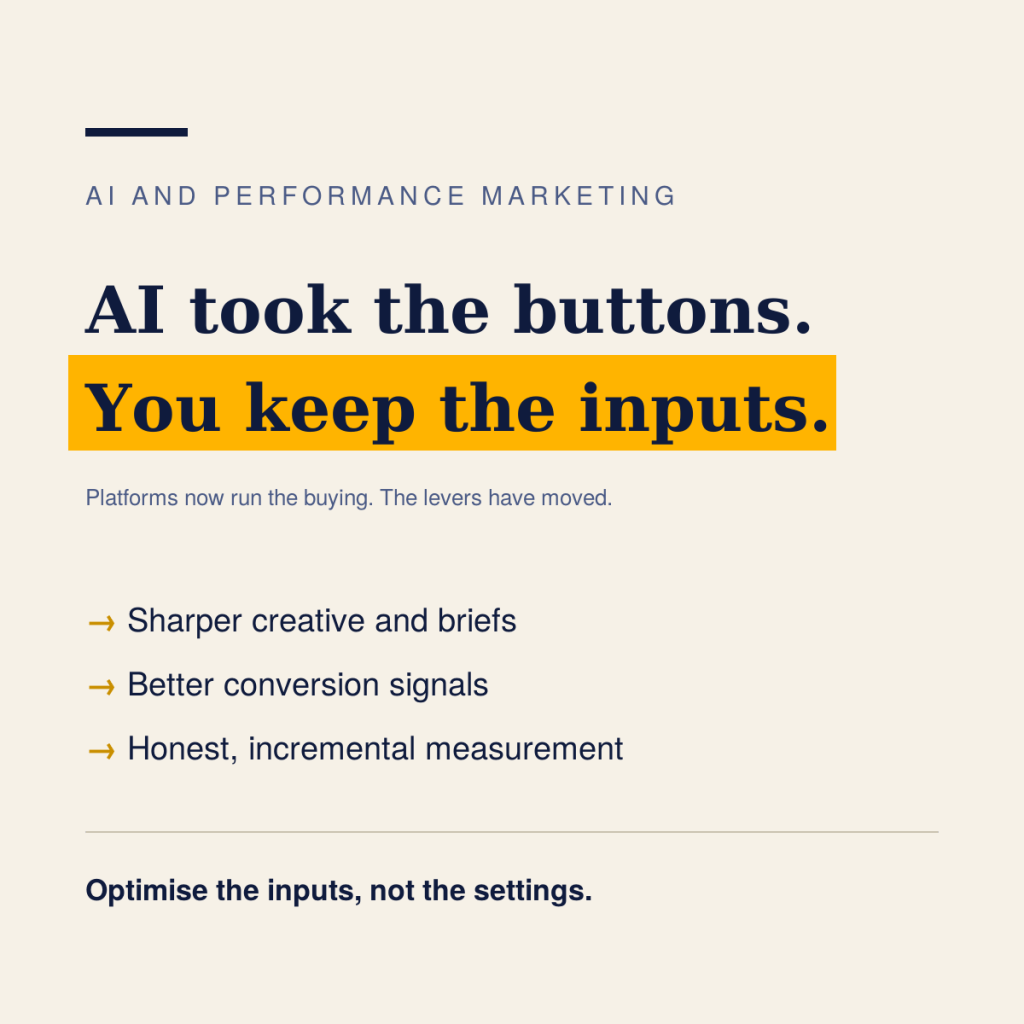
AI is not making performance marketing easier. It is moving the work. The platforms now handle bidding, audience targeting and increasingly the creative itself, so the old levers (keywords, audiences, bid tweaks) matter less every quarter.
What replaces them is a new set of levers: the quality of the creative you feed the machine, the quality of the conversion data you send back, and how honestly you measure what actually worked. The teams that treat those three as their job will keep an edge. The teams that still optimise campaign settings are optimising the part the platform has already taken.
This post walks through five shifts: automated buying, creative as the main lever, strained measurement, changing search, and agents.
1. Buying is being automated, and control is being traded for scale
The two biggest ad platforms have moved to the same model: you set a goal and a budget, and the system decides who sees what, where, and at what price.
- Meta. Meta reported that Advantage+ sales campaigns improved return on ad spend by an average of 22% across 2025, and that automated Advantage+ structures became the default for sales, leads and app objectives, with manual controls still available (PPC Land, reporting Meta’s Q4 2025 results of 28 January 2026). The Wall Street Journal reported in June 2025 that Meta aims to let an advertiser supply a product image or URL and a budget, with AI generating the creative and choosing the audience by the end of 2026. That is a reported goal, not a confirmed product (Pixis, a vendor blog citing the WSJ).
- Google. AI Max for Search adds broader search-term matching, text customisation and final-URL expansion, with controls for brands, locations and URLs. Performance Max has added channel-level reporting and asset segmentation. Ads can also show in AI Overviews, but advertisers cannot target that placement directly (ALM Corp, a secondary summary that does not link Google’s own announcements).
The results are real but self-reported. Meta’s 22% is Meta’s own average. A vendor blog cites 640 incrementality tests by Haus that reportedly found Advantage+ campaigns underperforming manual ones over time despite strong platform-reported ROAS (Pixis).
The practical point does not depend on who is right. When the platform marks its own homework, the advertiser’s job shifts from adjusting settings to checking whether the results are incremental.
2. Creative becomes the main lever
When targeting is automated, the creative does the targeting. Different images, hooks and messages attract different people, and the algorithm learns who responds to which. That makes the volume and range of creative the input you can still control.
The platforms are moving fast to make that input cheap:
- Meta says its video generation tools reached a $10 billion combined revenue run-rate (PPC Land, reporting Meta’s Q4 2025 results).
- At Advertising Week on 6 October 2026, Meta announced that Advantage+ Creative’s tool for turning static images into video ads is generally available, that Ads Creative Studio now has broader access, and that its AI business assistant can take in your brand-voice and strategy documents (TechJuice).
Cheap creative changes the job in three ways. This part is my analysis.
- Testing moves from A/B pairs to many variants. The scarce skill is no longer producing the next ad, but deciding which ideas deserve a test.
- The brief becomes the product. A model fed a vague brief produces the same average ad as everyone else’s model. A sharp insight, a distinct tone and clear claims are what make the output different.
- Brand risk rises. Generated ads can drift from your voice or make claims you cannot support. Guardrails (approved claims, tone rules, banned phrases) have to exist before volume goes up, not after.
One commonly quoted statistic says 70 to 80% of ad performance comes from creative quality.
3. Measurement is under strain
Automation makes measurement harder in two ways. The platform decides who sees the ad, so you can no longer infer much from the audience you picked. And the same platform reports the results, so credit is awarded by the party being judged.
Marketers are responding. A July 2025 EMARKETER and TransUnion survey found 52% of US brand and agency marketers use incrementality testing and experiments, and 36.2% plan to spend more on it in the next 12 months. But adoption is ahead of maturity: an IAB and BWG Global study found three in four marketers say their measurement does not deliver the speed, accuracy or trust they need (EMARKETER).
Platforms are adapting too. Meta says its incremental attribution product reached a multi-billion-dollar annual run-rate about seven months after launch, and that it delivered 24% more incremental conversions than standard attribution (PPC Land, quoting Meta’s Q4 2025 call).
The measurement stack I would aim for, which is my view and not a standard:
- Platform reporting for daily optimisation, read with scepticism.
- Incrementality tests (geo or holdout) on your biggest channels, to check that platform-reported results are real lift.
- Marketing mix modelling to see the whole budget, including offline and brand spend, and to calibrate the other two. I covered this in my post on why MMM is back.
No single layer is enough. The discipline is to let each one check the others.
4. Search is changing under your feet
Search is the backbone of most performance programmes, and AI answers are reducing the clicks available. Two pieces of evidence, both with limits:
- Seer Interactive studied 3,119 informational queries across 42 client organisations from June 2024 to September 2025. On queries showing an AI Overview, organic click-through rate fell from 1.76% to 0.61% (a 61% drop) and paid click-through rate fell from 19.7% to 6.34% (a 68% drop). Brands cited in the overview had higher click-through rates than those not cited, 91% higher on paid, though the researchers say they cannot prove citation is the cause (Seer Interactive via PPC Land). The sample is agency clients, informational queries only, and the paid sample is small.
- SparkToro estimated that about 68% of US Google searches from January to April 2026 ended without a click, up from about 60% in 2024. Only about 0.34% of searches had moved into AI Mode in that period (SparkToro via TechWyse). The data is panel-based with assumptions, and the rise cannot be cleanly pinned on AI Overviews.
For a performance marketer, the lesson is narrower than “search is dead”. The clearest click losses are on informational queries. Neither study isolates queries with clear buying intent, so I would not assume the same drop applies there, and I would not assume it does not. Plan for fewer cheap clicks at the top, and for competing to be the cited source, which is the same visibility work as answer engine optimisation.
Google’s ad response is to place ads in and around AI answers, where advertisers cannot target the placement directly (ALM Corp). That makes broad match, strong assets and good conversion signals more important, not less.
5. Agents arrive on both sides of the click
Agents are showing up as media buyers and, increasingly, as shoppers.
Agents as media buyers. Meta opened its Ads MCP server to any developer with a Meta app (published 16 July 2026, updated 22 September 2026). Agents connected to it can create, edit and delete campaigns, ad sets and ads, manage audiences and catalogs, pull performance reports, check signal quality and run A/B tests and conversion lift studies. Meta lets you set rules that limit what an agent can do on an account, such as read-only access (Meta for Developers). Google’s Ads MCP server, per one integration guide dated 14 June 2026, is read-only for now (ContentGrip).
Agents as shoppers. Meta is testing direct checkout inside Meta AI with Adyen, PayPal, Shopify and Stripe, and its Business Agent on Messenger already supports in-chat checkout (TechJuice). When the purchase happens inside an assistant, the ad click that your funnel depends on may never occur.
What this means, in my view:
- Permissions are now a marketing decision. Decide what an agent may change (budgets, creative, audiences) and what it may only read, and who signs off. Meta’s rule system is built for this.
- Routine work gets automated first. Reporting, pacing alerts and catalogue fixes are the obvious candidates. Judgment about brand, claims and budget allocation should stay with people.
- Your product data and site become the interface. If an agent compares you with a rival, clean, accurate and structured product information decides who gets picked.
What to do in the next 90 days
- Audit the conversion events you send to Google and Meta. Add a downstream, value-bearing event and remove weak ones.
- Run one incrementality test (geo or holdout) on your largest paid channel, and compare it with the platform-reported result.
- Write a creative brief template with the insight, the proof, the approved claims and the banned phrases, and use it for every AI-generated batch.
- Build a swipe library of approved claims and disclosures that generative tools must draw from.
- Track click-through rate and conversions on informational and high-intent queries separately, so you can see where AI answers are eating clicks.
- Start an answer-engine visibility check: ask the ten questions customers ask and note who is cited.
- Pilot a read-only agent for reporting and alerts, with written rules on what it may never change.
- Review brand and performance budgets together once a quarter.
The takeaway
Performance marketing is not being replaced by AI. It is being split in two. The platform takes the mechanical work of buying, and the marketer keeps the parts a model cannot supply: a real insight, a distinct brand, honest measurement and the judgment to say no. The marketers who do well will be the ones who get better inputs and better proof, not the ones who push more buttons.
Sources
Pages opened for this post, as of 19 October 2026. Secondary and vendor sources are flagged in the text.
- PPC Land: Meta’s ad business hits record $58B: trade coverage of Meta’s Q4 2025 results (28 January 2026). Figures are Meta’s own.
- Pixis: Meta’s fully automated ads by 2026: vendor blog citing a June 2025 WSJ report; the Haus findings are unverified.
- ALM Corp: Google Ads updates 2026: secondary summary; no links to Google’s announcements.
- TechJuice: Meta AI ad tools at Advertising Week 2026: secondary coverage of Meta’s 6 October 2026 announcements.
- Seer Interactive study via PPC Land: AI Overviews and click-through rates, November 2025.
- SparkToro data via TechWyse: zero-click search estimates, January to April 2026.
- EMARKETER: FAQ on incrementality: marketer survey data on measurement.
- Meta for Developers: Ads MCP server: Meta’s own documentation.
- ContentGrip: Ads MCP servers: Google Ads MCP server details.

