The festive buying window is already open, and a growing share of shoppers may be asking an AI to help them decide before they ever see your ad or visit your store. That changes what your offer needs to be: not just attractive, but easy for a machine to read, compare and describe correctly.
This post covers what research from Google and others says about AI-assisted festive shopping in India, how an AI answer is likely to treat your offer, what it means for financial services brands, and a short plan for this week, festive week and after. What the research says about AI-assisted festive shopping in India
The best-documented source is Google’s own, so read it as Google’s view. In an 8 October 2026 blog post, Google India drew on an Ipsos survey it commissioned. The survey covered 2,450 Indian shoppers aged 18 and over who had shopped for Navratri or Diwali in the previous two days, across seven categories including jewellery, apparel, mobile devices and appliances. It was fielded from September to November 2025, so it describes last year’s festive season, not this one (Google India). Its main findings:
- 51% of festive shoppers who used AI said it helped them make better decisions, and they consulted chatbots about 7.5 times on average.
- Among people who used AI chatbots, 94% also used Google Search and 87% also used YouTube. AI adds a step to the journey. It does not replace the others.
- 73% looked to online creators for inspiration, and 7 in 10 shoppers who spotted a product on a social feed turned to Google Search to check it.
- 90% saw delivery within two days as essential, and 81% chose a retailer on delivery speed.
A second source, InMobi, an ad-tech vendor, reports that about 4 in 5 festive shoppers want AI shopping assistants, and that 27% rank brand trust as their top purchase factor against 22% for discounts. Its press release gives no sample size or method, so I would treat those figures as directional only (InMobi, 24 September 2026). It also reports that 29% of shoppers buy a week or less before the festivals begin, which is the window we are in.
The pattern across both is consistent, even if the numbers need care: people research deliberately, use several channels including AI, and then buy quickly when something is easy to trust and easy to get. Neither source covers financial products specifically.
How an AI answer is likely to treat your offer
This section is my analysis, built on what is publicly known about how these tools behave. Nobody outside the platforms knows exactly how they pick and summarise offers.
A festive offer is a short-lived, detailed claim: a rate, a cashback, a date range, conditions. That is exactly the kind of thing an AI answer can get wrong in three ways:
- It can quote an old version. If last year’s offer, or an expired one, is still on a page, a partner site or a PDF, an answer may repeat it. Google’s guidance for its AI features asks site owners to keep business and product data current in Merchant Center and Google Business Profile (Google Search Central).
- It can drop the conditions. A summary tends to keep the headline and lose the fine print. “Up to 10% cashback” can become “10% cashback”.
- It can misattribute. A BBC-led study with the European Broadcasting Union found 45% of AI assistant answers to news questions had at least one significant issue, and 31% had sourcing problems (Al Jazeera). That study covered news in 2025, not offers, but the failure mode of a confident answer that does not match its source is the same one.
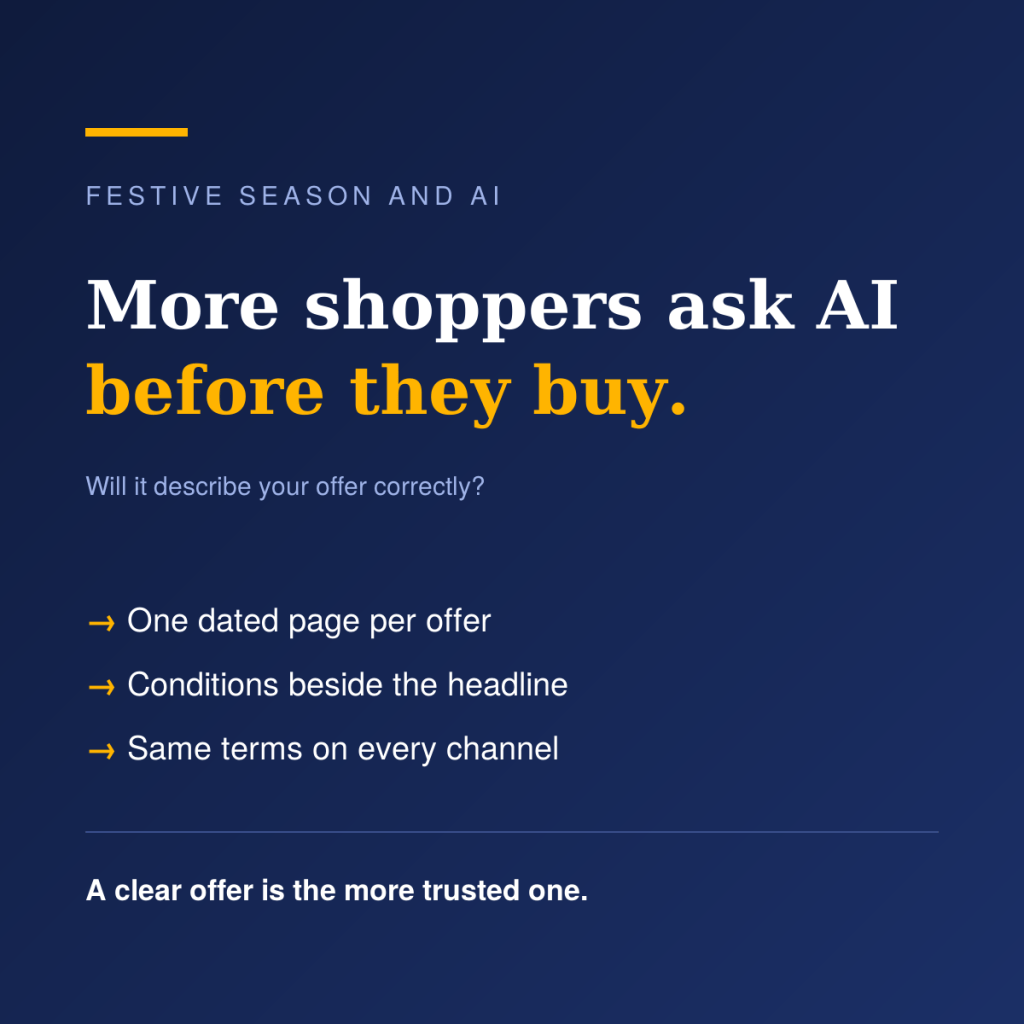
What helps is the same thing that helps in any AI answer: one clear, dated, factual page per offer, with the conditions in plain words next to the headline, and the same terms everywhere the offer appears.
What it means for BFSI and fintech brands
The festive calendar this year is tight. One calendar source gives Dhanteras on Friday 6 November and Diwali on Sunday 8 November 2026, though it notes religious dates can shift by a day or two depending on the calendar followed (India Marketing). That leaves days, not weeks, for anything not already live.
For financial services, four things stand out:
- A festive offer is a regulated claim, and an AI will repeat it. Card cashback, a processing-fee waiver or a festive rate has conditions, a validity period and, often, required disclosures. Put them in the same place as the headline, in plain language, so a summary is less likely to separate them.
- Big-ticket purchase moments create finance questions. Shoppers comparing a phone, jewellery or appliances ask about EMI, no-cost EMI, card offers and loan terms. Those are questions an assistant may answer using whatever it finds. Make sure the correct terms for your products are easy to find and consistent.
- Trust is the tiebreaker. If, as one vendor survey suggests, shoppers weigh brand trust nearly as much as discounts, a financial brand should lead with clarity and credibility, not only the offer. Treat that survey as directional, since it discloses no method.
- Speed matters, but not at the cost of accuracy. The research shows people buy fast. A wrong figure in a fast-moving answer creates a complaint you will have to handle in the busiest week of the year.
Be careful about promising returns or outcomes in festive creative, and check each offer against your compliance team’s rules and each platform’s policies before it goes live.
What to do now
Before Diwali (the next few days)
- Ask five of the questions a shopper would ask about your festive offer in the AI tools your customers use. Note what each says about your offer and whether it is right.
- Make one dated, plain-language page per live offer: the headline, the conditions, the end date and who it is for.
- Take down or clearly mark expired offers, including old PDFs, partner pages and app store text.
- Check the offer terms match on every channel: site, app, social, partner pages and sales scripts.
- Brief service and sales teams on the exact wording, since customers will arrive quoting what an AI told them.
- Update Google Business Profile and any product feeds with festive hours and offers.
Festive week
- Re-run your five questions daily and log any wrong answer with a screenshot.
- Fix the source of any error you can control. Report the rest through the platform’s feedback route where one exists.
- Keep a named person on call for corrections, with compliance sign-off ready.
After the festival
- Compare what AI said about your offer with what you intended, and note the gaps.
- Retire every festive page with a clear end message, not a silent deletion.
- Write the lessons into next quarter’s offer checklist.
What not to do
- Do not rely on the offer headline alone. If the conditions are not near it, they may not survive a summary.
- Do not publish dozens of near-identical festive pages. Google calls mass-producing pages to manipulate rankings or AI responses scaled content abuse (Google Search Central).
- Do not chase AI visibility tools mid-campaign. Google says no third-party tool has access to its internal ranking or AI systems, so a score is a sample, not a measurement.
- Do not let generated festive creative skip review. A fast tool and a short deadline are when wrong claims get through.
- Do not treat AI as the only channel. In Google’s survey, nearly all chatbot users also used Search and most also used YouTube.
How to measure what worked
Keep it small enough to do in a busy week.
- Answer accuracy. Of the answers you checked about your offer, how many were right on the headline and the conditions? Log each error and its source.
- Offer-page performance. Visits, applications and completions on the dated offer pages, compared with the same pages before the festive push.
- Customer questions. The number of service queries that quote an offer wrongly. This is the cost of an error showing up in your own data.
- Brand search. Branded search volume in Search Console before, during and after, as a sign that your name is being looked for.
With a few days of data and a small question set, you are looking for direction and for errors to fix, not proof that AI drove sales. Write down your five questions now so next year’s comparison is fair.
The takeaway
Shoppers are using AI as one more step in a journey that still runs through search, video and creators. For a festive offer, the practical risk is not that AI ignores you. It is that it describes your offer wrongly, in the week you can least afford it. Make each offer easy to read, dated and consistent, check what the answers say, and fix what you can. In financial services, a clear and correct offer is the more trusted one.
Sources
- Google India: India’s two-speed festive shopper: Google blog, 8 October 2026, citing an Ipsos survey of 2,450 shoppers fielded September to November 2025.
- InMobi Advertising festive report: ad-tech vendor press release, 24 September 2026; no sample size or method given.
- India Marketing: Diwali 2026 dates: festival dates; religious dates may shift by a day or two.
- Google Search Central: optimising for generative AI search: Google’s own guidance.
- Al Jazeera: EBU and BBC study on AI assistants: accuracy of AI answers to news questions, 2025.

