Clicks are now a weaker signal of brand
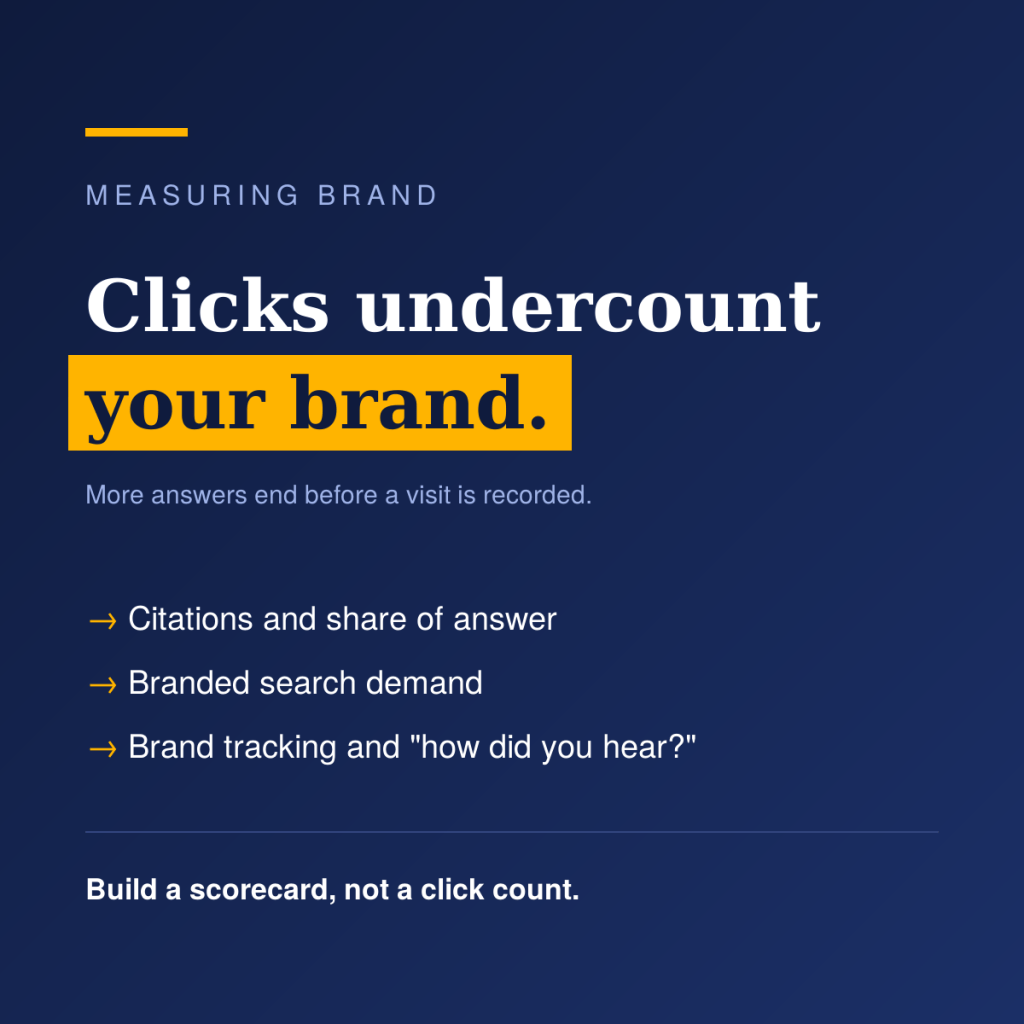
More of the journey now ends inside an answer, so a brand can be seen, summarised and chosen without a visit ever being recorded. Clicks still matter, but they no longer tell you how many people met your brand.
The best controlled evidence I found is a field experiment reported by Search Engine Journal. Researchers from the Indian School of Business and Carnegie Mellon randomly assigned 1,065 US participants to normal Google Search, Search with AI Overviews hidden, or AI Mode, and tracked them for two weeks in January and February 2026.
- AI Overviews appeared on 42% of queries.
- Where they appeared, outbound organic clicks fell 38%.
- Zero-click searches rose from 54% to 72% when Overviews were shown.
- Sponsored clicks and search frequency stayed steady.
Treat it with care. It is a working paper that has not been peer-reviewed, the sample is active US desktop Chrome users, and the AI Mode results are described by the authors as exploratory. It says nothing directly about India or about financial services.
The point for measurement is simple. If fewer people click, then click-based metrics undercount exposure. The brand effect has not disappeared; it has moved to places your dashboard does not look.
A replacement scorecard
No single number replaces clicks. A working scorecard pairs platform data on where you are cited with your own measures of awareness and demand. Seven measures cover it:
| Measure | Question it answers | Where the data comes from | Cadence |
|---|---|---|---|
| Citations and citation share | Do AI answers cite our pages, and how often relative to others? | Bing Webmaster Tools AI Performance report, public preview | Monthly |
| AI impressions | How often do our pages appear in Google’s generative features? | Search Console generative AI reports, limited rollout, per PPC Land | Monthly |
| Mentions and clicks in ChatGPT | Is ChatGPT mentioning us, and are people following links? | ChatGPT Business Hub, beta | Monthly |
| Share of answer | Are we in the answer, and what does it say about us? | A fixed prompt log you run yourself | Weekly |
| Branded search demand | Are more people looking for us by name? | Your own search data | Monthly |
| Brand tracking | Do people know and trust us? | A recurring survey | Quarterly |
| Self-reported source | How did new customers say they heard of us? | A form field or sales-call note | Ongoing |
The first three tell you about AI visibility and come from the platforms. The last four are measures you own, and they stay valid whichever platform changes its reporting next.
How to run each measure, and where it falls short
Platform data
- Bing citations. Per Bing’s announcement, the report shows where your content is cited across Copilot, Bing and select partner experiences. Citation Share is your share of citations for the same grounding query. Bing calls it observational: it does not expose competitor domains, traffic share or quality scores, and citation patterns can shift for reasons outside your control. Intents, Topics and Compare were added on 16 June 2026 and remain in preview.
- Google generative AI impressions. Per PPC Land, summarising Google’s 3 June 2026 announcement, the new reports show impressions, pages, countries, devices and dates for generative features, and the same impressions remain in your overall totals. They are rolling out to a subset of sites. The article’s author notes that clicks are not among the listed metrics, which is commentary, not a Google statement.
- ChatGPT Business Hub. Mentions and clicks, with OpenAI’s own help text saying clicks do not confirm visits or conversions. Covered in my earlier post on ChatGPT’s search console.
Measures you own
- Share of answer. Fix 10 to 15 customer questions, run them weekly on the AI tools your customers use, and record presence, position and accuracy. Keep wording and settings constant, or the trend means nothing. Results vary from run to run, so read the direction over weeks, not any single day.
- Branded search demand. Track searches that include your name or product names. A rise suggests more people are going looking for you after meeting you elsewhere. It cannot show where they met you.
- Brand tracking. A short quarterly survey on awareness, consideration and trust, with the same questions each time. It is slow and costs money, but it is the only measure that asks people directly.
- Self-reported source. One open question on every enquiry form or sales call: how did you first hear about us? Add “AI assistant” as an option. The answers are imperfect and people forget, yet they surface channels that analytics cannot see.
No one measure is reliable alone. The value is in watching whether they move together: citations and share of answer rising, then branded demand, then enquiries.
A 30-day plan to start
Week 1: set the baseline
- Pick 10 to 15 customer questions and run them on the AI tools your customers use
- Record presence, position and accuracy for each
- Pull 90 days of branded search data
Week 2: switch on the platform reports
- Verify your site in Bing Webmaster Tools and open the AI Performance report
- Check whether Search Console shows generative AI reports for your property
- Try claiming your business in ChatGPT, if you are eligible
Week 3: add the human signals
- Add “How did you first hear about us?” with an AI assistant option to forms and call notes
- Draft three brand-tracking questions for the next survey
Week 4: report and agree the rules
- Build a one-page scorecard with the seven measures
- Agree with compliance how wrong AI answers are escalated
- Re-run the prompts and compare with week 1
The first month gives you a baseline, not a verdict. The trend over the next quarter is what the scorecard is for.
Sources
- Search Engine Journal: study on AI Overviews and organic clicks, coverage of a non-peer-reviewed working paper
- Bing Search Blog: new AI visibility insights in Bing Webmaster Tools, official, June 2026
- PPC Land: Search Console’s generative AI visibility reports, secondary coverage of Google’s 3 June 2026 announcement; I did not open Google’s own post

