
The short answer
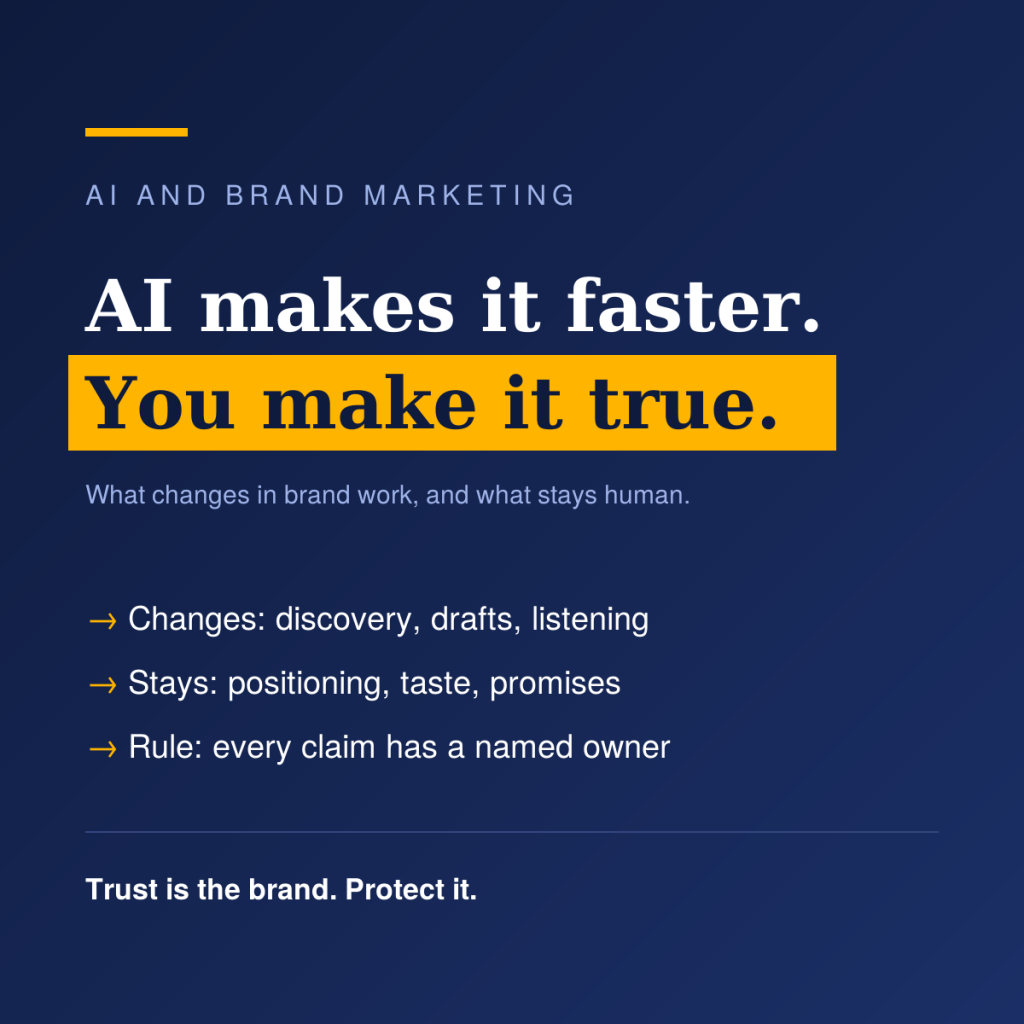
AI changes how a brand is discovered, produced and measured. It does not change what a brand is: a promise customers believe because it has been kept.
That split is useful for planning. The first group of jobs, such as drafting, adapting, listening and reporting, gets faster and cheaper, and the gain goes to teams that use it well. The second group, positioning, taste, trust and keeping promises, cannot be sped up, and it becomes the main source of difference when everyone else can produce polished content in minutes.
This post sets out five places AI is changing brand work, what stays human, and where the risks are. It closes with a working rule your team can adopt.
Five places AI is changing brand work
| Job | What changes | What to watch |
|---|---|---|
| Discovery | Customers ask an assistant and see a summary, not ten links | The summary may be wrong or out of date, and you do not write it |
| Content production | First drafts, variants and adaptations take minutes | Sameness, and drift from your voice |
| Consistency | Brand rules can be turned into prompts and automated checks | Vague rules produce vague checks |
| Listening and research | Reviews, support transcripts and social posts can be summarised at scale | Privacy, and a sample that leaves out quiet customers |
| Measurement | Clicks give way to mentions, citations and share of answer | New metrics are young and platform-defined |
Two of these connect to earlier posts in this series. On discovery, how AI describes you is the subject of my posts on answer engine optimisation and share of answer. On measurement, the scorecard is in Measuring Brand When Clicks Disappear.
The common thread is that AI lowers the cost of producing and checking, so the scarce thing becomes deciding what to say and noticing when something is off.
What AI leaves alone
Four parts of a brand do not get cheaper with AI, and they are the ones customers pay for.
- Positioning. Deciding who you are for, and who you are not for, is a choice with trade-offs. A model can list options, but someone has to accept the cost of choosing.
- Taste. Judging which of twenty drafts feels like your brand needs a person who has lived with it. AI widens the field; it does not pick.
- Promise-keeping. A brand is what customers experience after the campaign: the call that is answered, the fee that matches the ad. No tool writes that into the product.
- Accountability. When something goes wrong, a customer wants a named person or team to answer, not a system.
A useful test for any AI use in brand work: if it goes wrong, who explains it to the customer? If the answer is nobody, a human step is missing.
The risks, and what consumers say
The clearest recent data is on disclosure. A Cint survey of about 1,000 US consumers, fielded in August 2026, found:
- 74% say brands and creators have a duty to disclose AI use in advertising.
- 44% say finding undisclosed AI-generated ads would lower their trust in the brand.
- 46% dislike AI-generated people in ads, the most disliked category tested.
- 40% liked realistic AI-generated landscapes, the most liked.
Read this with care. It is a press release from a research vendor, with no margin of error or question wording published. It covers the US only and measures stated attitudes, not behaviour.
Three further risks come from my own reading of the work:
- Sameness. If every brand drafts with similar tools and prompts, outputs converge. Distinct voice and real specifics are the defence.
- Wrong answers about you. Assistants may describe your products inaccurately, and you do not control the text. Regular prompt checks are the only way to see it.
- Data leakage. Customer details pasted into a public tool can create privacy and compliance exposure. Keep personal data out of prompts.
I have not covered advertising disclosure rules, which differ by country and sector. Check them with your legal team before setting a policy.
What this means for BFSI marketers
In financial services the brand is trust, and customers hand over money, data and long-term plans on the strength of it. That raises the cost of every AI shortcut.
- Use AI hardest where the risk is lowest. Drafting internal briefs, summarising research, and adapting approved copy to new formats carry little exposure. Rate, fee and eligibility claims need a human check and compliance sign-off every time.
- Build one approved source of truth. A single dated record of product terms that AI tools draw from reduces the chance of an outdated claim reaching a customer or an assistant’s answer.
- Decide on disclosure early. If customers expect to be told when AI made an ad, as the US survey suggests many do, it is easier to set a clear policy before a complaint than after one.
- Protect the human moments. Complaints, claims and hardship conversations are where trust is won or lost. Automate the preparation, not the empathy.
A brand that is accurate, consistent and honest about its tools is in a better position as AI makes polished content cheap for everyone.
A working rule and a checklist
The rule: let AI make it faster, and let a person make it true. Speed is the gain; accuracy, taste and accountability stay with a named owner.
- List the brand jobs your team does and mark each as AI-assisted, AI-checked or human-only
- Turn your brand voice into a one-page brief that a tool and a new hire can both follow
- Name one owner for each customer-facing claim, and keep one dated source of truth for product terms
- Ban personal customer data from public AI tools
- Agree a disclosure position with legal and compliance
- Run a fixed set of customer questions through an assistant every week and log what it says about you
- Review the list every quarter, since the tools and the rules will keep changing
Sources
- Cint: report on US consumers and AI disclosure in advertising, vendor press release of 20 October 2026; about 1,000 US consumers, fielded August 2026

