• Content marketing Plan is required by businesses for meeting their Marketing and business goals. Create a Content marketing plan in these eight easy steps.

    Start  With Your Content Marketing Goals

    Start with defining your goals. The goals could vary from building trust with your customers to raising awareness or deepening loyalty with existing customers. The goals should be SMART (Specific, Measurable, Achievable, Realistic and Timely). Each goal should have a budget assigned to it and check your performance against the budget to achieve the best ROI.

    Identify Personas

    Build a buyer persona for your audience. Identify the top two personas for customers you wish to target. A buyer persona deals with your customers motivations, pains, trusted sources and process of how consumers consume your content. Based on Buyer Persona, yo can determine how you want to tell your brand’s story to them.

    Keyword Research

    Identify the most profitable keywords for your buyer persona. Study competition to understand the keywords they are using to target audiences. Use Free keyword research tools to identify the right keywords.

     Content Marketing Planning Sheet
    Your blog posts, emails, eBooks, social media posts and podcasts need to fit into a bigger picture. Start with audience personas that you are targeting and create a plan to target each
    Points to keep in mind while creating your content marketing Planning Sheet or Calendar:
    What are the most often asked questions for each buyer persona? What are the different buying stages?
    What is the conversation surrounding your brand or category? Collect all possible information by tracking social mentions, Google alerts and any  other source of tracking information.
    What are the preferred content formats? This could be written text, images, infographics, videos, podcasts etc.
    When is the best time to publish? Day, Date, Time
    What is the best way to reach your audience?
    Seasonality and  Holidays
    Write and Optimize Your Content

    Optimize your content for Search Engines, to ensure that your content can be found. This can be done by optimizing your content for SEO, following copywriting tips and a checklist for your blog posts.

    Publish Your Content

    Publish your content on all available platforms including blog, forums, LinkedIn and other third-party sites.

     Promote Your Content

    Promote your content on Social Media sites, and brand sites. Share teasers of your content with paid search and brand sites.

    Measure Refine and Repeat

    Measure the performance of your content by mapping the performance for key metrics.

    1. Consumption Metrics

    2. Sharing Metrics

    3. Lead Generation Metrics

    4. Sales Metrics

  • content-marketing-v-native-advertising-e1455737776839

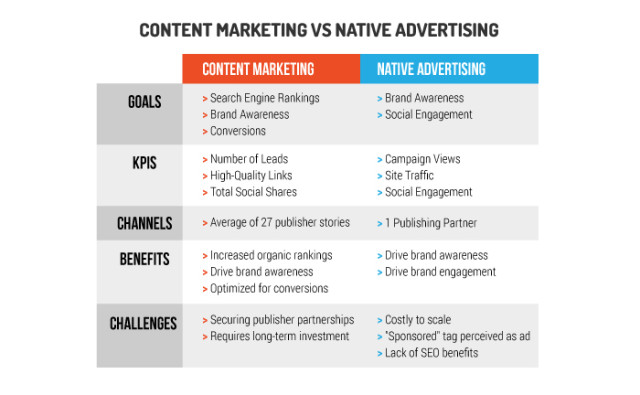
    Telling the difference between Content Marketing and Native Advertising may not be easy. Here is a summary of key differences that can help you understand how to choose the approach that is right for your brand.

    For Content Marketing the goals are throughout the marketing funnel right from generating awareness to increasing conversions. For native advertising the awareness goal is of paramount importance.

    Content Marketing

    content


    Content Marketing deals with bringing informative, educational or entertaining content to users in the format that helps brands change perception, create awareness or increasing conversions in a way that content answers the queries of customers.

    Content Marketing is also seen as a tool for optimizing content for Search Engines to improve your site’s page rank.

    As a marketing strategy Content Marketing, provides long term sustainable value for clients where KPIs are linked to number of leads, shares and high quality links.

    Content Marketing targets different audience personas with a story telling approach designed to answer specific queries.

    Native Advertising

    native


    Native Advertising follows the natural form and function of the user experience, characterized by special ad format. They follow the editorial guidelines of the publication, to make the brand content seem like an editorial.

    Designed to look like the editorial content they appear in the users direct reading flow and do not disrupt the user experience.

    Designed for the native flow the ads are labeled  as “sponsored” or “ad”. The ads tend to be more persuasive as users are more open to messaging that follows the form of editorial content.

    Though Content Marketing and Native Advertising deal with similar goals of awareness generation, according to Social Times, “It’s important to note that the goals for content marketing and native advertising are very different. While both want to increase brand awareness, content marketing is also intended to drive conversions. This bears out in the key performance metrics as well: The number one metric for content marketing is the number of leads generated, where native ads usually depend on engagement metrics and impressions.”

    To see examples of Native Advertising, click here.

    For Content Marketing Innovations, click here.


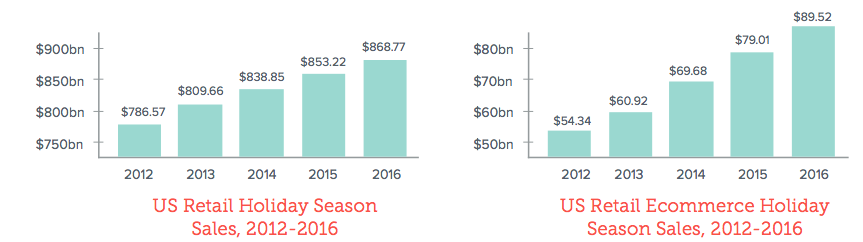
  • Holiday 2015 brought in a 60 percent growth in traffic and conversion rates.  The US retail online sales for Holiday Season 2016 are likely to grow by 13.3 percent according to eMarketer. Nearly 50 percent of shoppers have reported Holiday Shopping begins before Thanksgiving and nearly 25 percent start before Halloween.

    screen-shot-2016-09-21-at-9-39-35-am

    screen-shot-2016-09-21-at-9-46-57-am

    Optimizing your campaign for audience segments can get your campaigns and content discovered by the target audience . The content Eco-system for your audience segments varies for different demographic. Smartphones are essential in the content path of Holiday Shopper with 76 percent shoppers conducting a local search  and visiting a physical location within 24 hours.  Equally important is the growth of Buy Online and Pick Up in store with 32 percent using the option in 2015.

    screen-shot-2016-09-20-at-7-13-06-pm

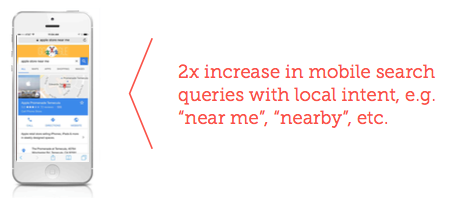
    Optimize your campaigns for local search intent. 82 percent of the shoppers refer to Smartphones while shopping prior to visiting a store. The Queries with Local Intent increased by 2X during Holiday season 2015.screen-shot-2016-09-21-at-10-12-30-am

    Define your audience segments and develop a persona for each audience segment. With profiles for each segment you can find out the purchase behavior for each segment, depending on the time they are likely to start shopping and the content that works for each persona. For instance, targeting teens with a personalization content strategy might work better, whereas for targeting  seasoned mature shopper, an opt-in email strategy might bring in best deals on a weekly basis.

    screen-shot-2016-09-21-at-9-35-47-am

    Your Content Marketing Strategy  centered around your audience ensures sustained interest, throughout the holiday season. Co-promote your offers and campaigns with publisher boosts to ensure sustained interest. This will help your brand with Organic search results. Some of the tactics recommended by SEO experts WPROMOTE are to leave your Branded content on the main site navigation for SERP results. The content pieces that are likely to work for your category depend on what is popular with your target audience. For some categories, Gift Guides work better, while for others an image caption contest may generate increased engagement.

    According to WPROMOTE’s “100 Days Of Holiday” Whitepaper, the SEO firm recommends updating your website content and Metadata with Holiday related terms as early as October.

    Some of the charts from comScore reveal the weekly ramp up of online holiday retail sales making it important for brands to think their Online holiday retail strategy to be ready with Text Ads and Display Ads, as well as Social media strategy to be ready for online searchers and holiday shoppers.

    screen-shot-2016-09-19-at-12-03-30-pm

    The Traffic for Mobile and Desktops varies for different weeks. Keep in mind the changes in traffic volume and searches on mobile to optimize your bids accordingly.

    screen-shot-2016-09-17-at-12-45-13-pm

    Source: WPROMOTE’s Whitepaper “100 Days of Holiday” and comScore

  • native

    Native Advertising is defined as “A form of paid media where the ad experience follows the natural form and function of the user experience in which it is placed”. According to an eMarketer report Native Advertising has made a big impact with half of all digital display advertising attributed to Native. The share of Native advertising is likely to reach  to three-quarters of all Display Spending by 2021. The key reason for rise in Native ads is that all advertising on Facebook and other social sites is native. The huge success of Facebook’s News Feed ads has helped boost native display spending to nearly  USD 17 billion this year, according to BI Intelligence.

    Among the ad formats preferred US millennials preferred native ad formats at 58 percent with banners coming at a distant second at 21 percent. The US Millennials are also agnostic to the native ad formats and don’t care if the content is sponsored by a brand, as long as it is entertaining or informative.

    native3

    (more…)

Create your own website, free on WordPress.com.Create your own website.
Start free