Budweiser’s teaser commercial for Super Bowl 50 features a video of a Clydesdale persuading a man to buy Budweiser for Playoffs, with a Voice-over where the horse persuades the shopper to buy Budweiser and an annotation, “It’s the Super Bowl, Act Like It”. The video creative for the spot #ActLikeIt appears to be similar to Super Bowl XLIX spot with #BestBuds, except here the Clydesdale is urging the shopper verbally rather than non-verbal cues. The commercial is visually gripping with the presence of a horse in a store and takes on the viewer’s imagination when the horse compliments the shopper as a parting remark in place of neighing on his choice of beer.
The video on Twitter Timeline has a different creative with the Beer and Burger replacing a cocktail. The campaign on Social Media channels is targeted at fans reminding them about the right way to prep themselves for Game Day.
Budweiser’s commercial for Super Bowl XLIX, played on an unusual friendship of the Clydesdale and dog. The Budweiser Super Bowl 2015 Ad titled “Lost Dog” continues the story between the friendship of a little puppy and a Clydesdale.
Anheuser-Busch’s advertising featuring Clydesdale, symbolic for unusual strength builds on the brand story where a Clydesdale driven beer wagon marks an important event. The Brand Story features an event in the marketing history of Budweiser when, on April 7, 1933, August A. Busch, Jr. and Adolphus Busch III surprised their father, August A. Busch, Sr., with the gift of a six-horse Clydesdale hitch. Another six-horse driven wagon was driven by Billy Wales to The Empire State Building, New York City, and a case of Beer was presented to the Former Governor Alfred E. Smith. To find out other interesting facts, click here.
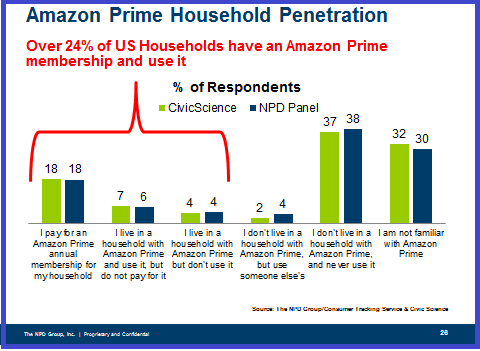
Amazon Prime according to a research survey by Cowen, penetrated nearly 40 percent of the U.S. market, with some 41 million members, according to a survey of 2,500 U.S. shoppers. An earlier research by NPD group indicated that over 24 percent of US Households had at least one Amazon Prime account.
For a limited time Amazon Prime is available at a discount according to a CNet Update. Amazon Prime membership is on sale until Sunday, for USD 73. Amazon Prime packs a host of free services including Instant Videos, video Game Discounts. For a detailed list of Amazon Perks, Click here.
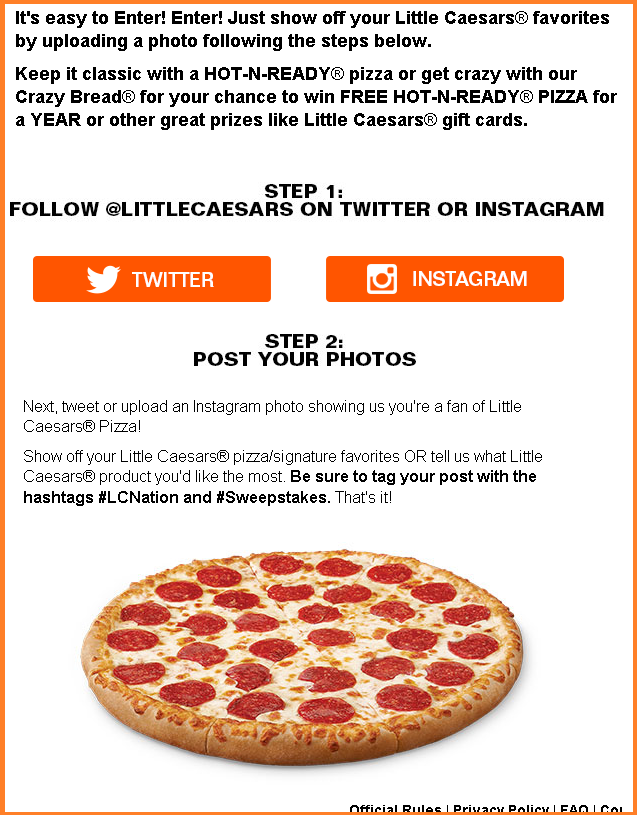
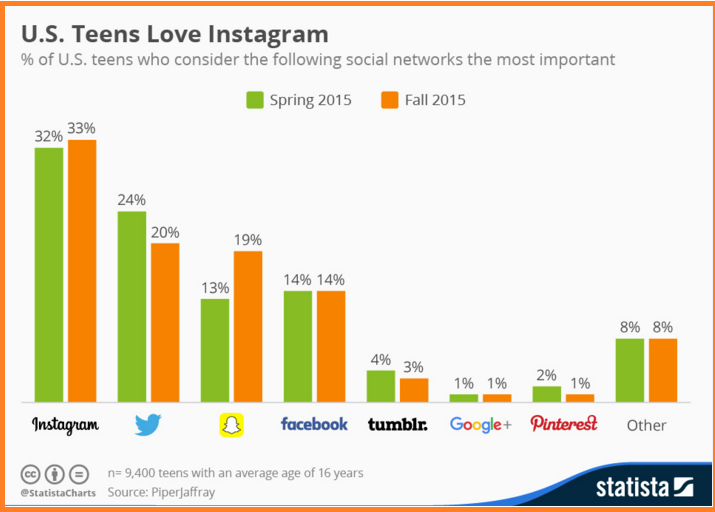
Little Caesar’s launched a sweepstakes Fan Photo Contest offering Free Hot-N-Ready Pizza for a year as a winning prize for the contest #LCNation. The contest has been launched on Facebook, Twitter and Instagram with posts that invite audiences to follow the social media account for the brand on Twitter and Instagram and share their best Little Caesar’s pizza pics with #LCNation and #Sweepstakes, with a chance to win Free Hot-N-Ready Pizza for a year. The social networks preferred by US Teens according to Piper Jaffray survey, place Instagram as the most important network based on a survey of 9400 teens above the age of 16 years.
Little Caesar’s has earlier launched a Nationwide sale, celebrating its best pizza ever, Detroit-Style DEEP!DEEP! Dish pizza, starting November 2 through November 15, 2015, for USD 6 in place of regular price of USD 8. Little Caesars Pizza, known for its HOT-N-READY pizza and famed Crazy Bread, is the largest carryout-only pizza chain in the world with locations in all 50 states and 18 countries and territories worldwide. Little Caesar’s is known for quality ingredients, such as fresh, never frozen, mozzarella and Muenster cheese, dough made fresh daily in every store and sauce made from farm fresh crushed tomatoes. Little Caesar’s Hot-N-Ready large pizzas are now available for USD 5.
User Generated Content For Gamification and Loyalty
Gamification is the new Loyalty game changer for brands with engagement rates higher than usual for brands that offer rewards for customers. Little Caesar’s has effectively used UGC for Gamification with a prize making audiences more loyal to the brand.
McDonald’s has earlier launched McDonald’s Game Time Gold Sweepstakes giving out,a grand prize for USD 500,000 every week, with winners announced on social media channels, based on codes, with no purchase necessary. Starbucks for Life gave five winning entries Free Starbucks For Life for contest that run from December 8, 2015, through January 11, 2016, with codes that they received on Starbucks purchases. For audiences who do not make it to the free Starbucks for Life win, 25 people won one year’s worth of free Starbucks, 125 won a month’s worth of joe, and 500 won a week’s worth.
Taco Bell launched Explore that rewards consumers for their behavior which is automatically detected with the app rewarding audiences for behavior such as mobile ordering or social media engagement.“As a brand, we wanted to create a unique experience that truly rewarded our fans for living their life and sharing online,” Taco Bell spokesperson representative Matt Prince told Loyalty360. “Rather than requiring consumers to just purchase menu items or interact with the brand to gain rewards, we’re connecting in a more personal way and tapping into an existing social habit to elevate what it means to ‘Live Mas.’”
A similar rewards program offered by Pepsi Pass rewards audiences allowing consumers to earn points by simply hanging out with their friends who also have the app, for a chance at hourly ticket prize-wins, or access a universe of prizes ranging from trips to top music festivals and concerts and dining credit with a range of Pepsi partner restaurants.
Little Caesar’s use of photo contest banks on existing consumer behavior of sharing photos, linked to a prize.
User Generated Content For Content Discovery
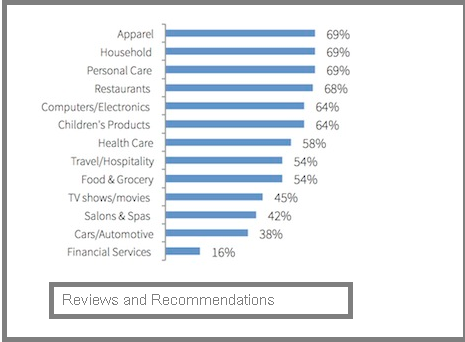
UGC is known to inspire trust in brands and trust in Reviews and recommendations varies for different categories, with 69 percent Trusting reviews and recommendations in restaurant category . For brands that link User Generated Content with Rewards are likely to inspire trust and loyalty from the audience.
Creating different iterations of UGC Contest linked to sweepstakes can engage different audience segments for your brand. Using UGC as a tactic for your Contests can strengthen the emotional bond for your brand with your audiences. A contest design preferred by audience segment helps audiences discover your brand content.
User Generated Content For Conversion
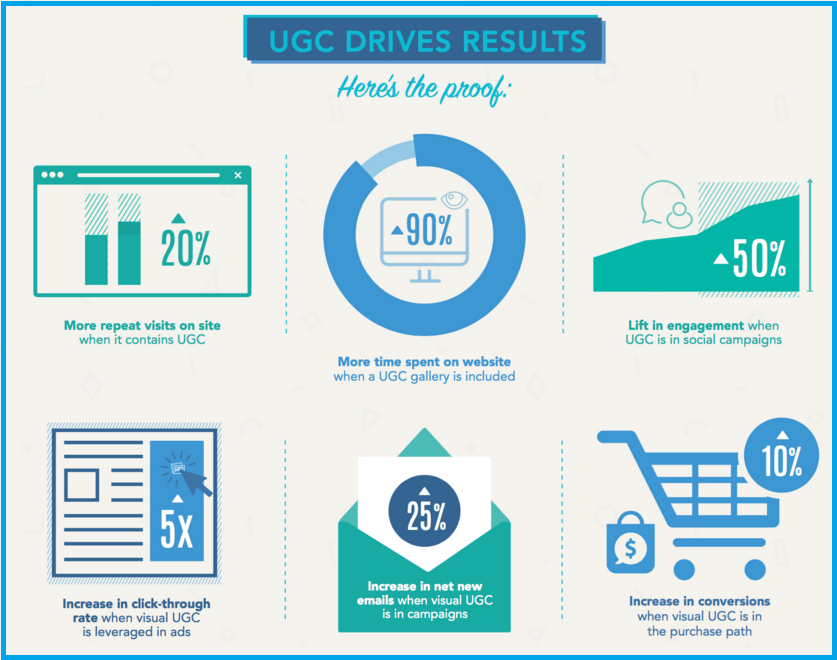
UGC increases CTR for your campaign by 5X when visual UGC is leveraged in ads, and increases conversions by 10 percent, according to statistics shared by OfferPop.
OfferPop found that there is a 50 percent lift in engagement with Visual UGC in social campaigns. Additionally, people tend to spend 90 percent more time on a website when a UGC Gallery is included. Effectively regramming UGC photo posts and including the photo posts in your brand content can increase conversion and CTR. According to SproutSocial, AEO uses Visual UGC for retention and influencer activation, “American Eagle Outfitters does a good job of this by encouraging customers to use the hashtags #AEOstyle and #AerieReal on Instagram and Twitter, letting them know that the best images will be featured on the brand’s website.”
UGC can be linked to referral marketing programs, such as tag five of your friends for increased chances for the draw.
UGC For Activation
Visual UGC can be linked to activation programs that require audiences to perform a certain action such as site visit, app download, subscription service sign up or sign up for a rewards program for increased chances to sweepstakes.
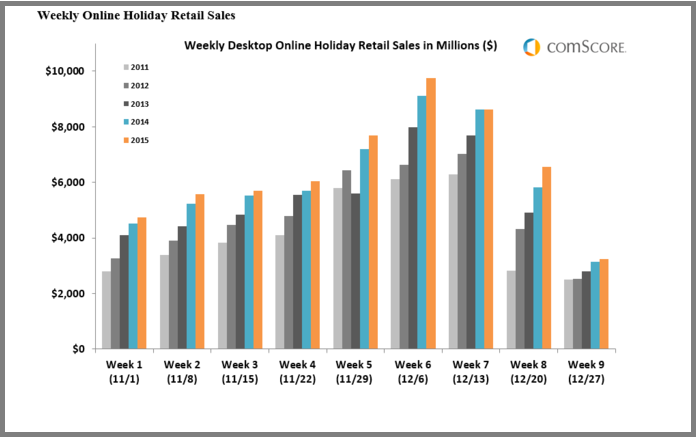
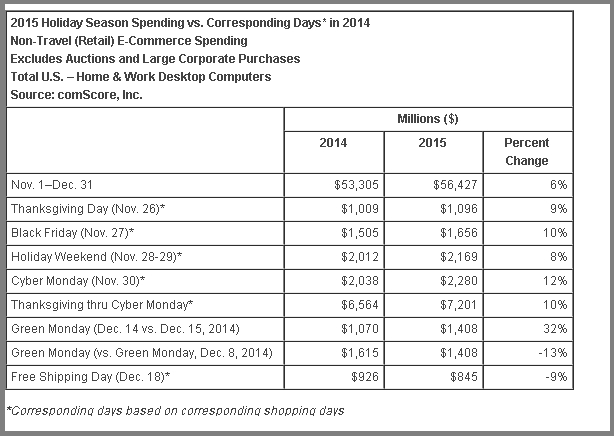
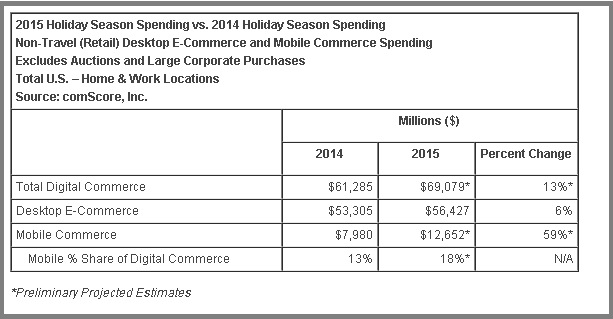
comScore has reported an increase of 13 percent with total online sales for the holiday season, reaching USD 69.1 billion, compared to USD 61.3 billion spent online during 2014 holiday season. USD 56.4 billion was spent online on desktop computers, marking a 6-percent increase versus the corresponding days last year, while online sales from mobile devices increased to USD 12.6 billion, marking an increase of 59 percent. According to comScore report, the Online Sales were highest for the Week starting December 6, the sixth week of Holiday Season.
Cyber Monday was the leading Sales day, sixth year in a row, with more than USD 2.2 Billion spent on Desktop Computers alone. Mobile commerce is estimated to have accounted for 18 percent of total digital commerce in November-December 2015, an increase from 13 percent in the previous season. Sales for the week of Thanksgiving, on average from Thanksgiving Day through Cyber Monday grew at 10 percent.
Mobile and Desktop Share of Online Sales
According to comScore chairman emeritus Gian Fulgoni. “Fairly early on it became clear that desktop e-commerce would likely underperform our expectations while mobile commerce was poised to over perform, but for the most part signs continued to point to hitting that 14-percent overall growth estimate. Where the season ultimately fell short was in the last two weeks of the year, and in particular the week before Christmas. We had anticipated heavy desktop spending through Free Shipping Day on December 18th that unfortunately did not materialize, and spending began to soften more than expected by the Wednesday of that week.”
The pure-play e-retail giant captured 39.3 percent of e-commerce sales from Nov. 1 through Dec. 6, up from 37.9 percent year over year, according to data from e-mail receipts of 3.5 million shoppers Slice evaluated.
Meanwhile, sales on Amazon’s marketplace rose 19.5 percent in the second week of December, beating the e-commerce growth overall of 15 percent, according to ChannelAdvisor, which helps sellers on Amazon’s marketplace.
More than 3 million people joined Amazon Prime in the third week of December alone, 200 million items were shipped for free to Prime subscribers, and more than two times as many Amazon devices were sold than last year during 2015 holiday season, according to The Verge and Amazon’s Press Release.
comScore’s holiday season forecast had expected desktop e-commerce to grow 9 percent to USD 58.3 billion and mobile commerce to grow 47 percent to USD 11.7 billion. While desktop spending fell short by 3 percentage points and USD 1.9 billion, preliminary mobile estimates suggest it exceeded forecast by 12 percentage points and nearly USD 1 billion, making for the shortfall on desktop.
According to Marketing Land “Much has been made of online retail surging and traditional retail suffering. But that “either/or” analysis is simplistic. Among online-only players, it’s really only Amazon and a couple of others that saw significant sales growth. The rest of online shopping gains came largely from traditional retailers’ online divisions.
In other words, traditional retailers’ e-commerce operations (and Amazon) are cannibalizing in-store sales. Yet traditional retail brands and stores support e-commerce by giving consumers the confidence to buy online with the expectation that they can return items locally if they don’t work out.”
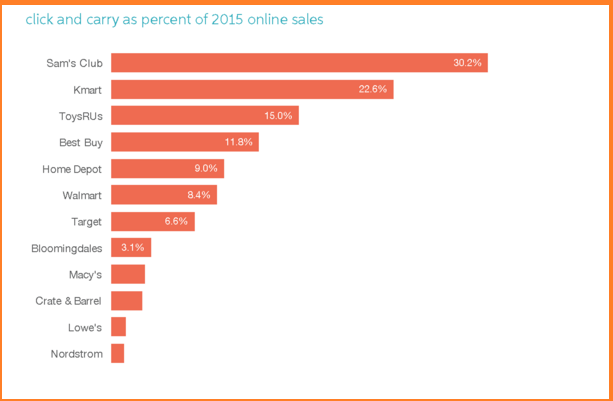
Though the Desktop Online Sales fell short of the estimate, the Mobile sales exceeded the Forecast by USD 1 billion, suggesting that the mobile shopping may be more popular for online purchases than expected. According to a report by Fierce Retail “Click-and-collect also proved popular with shoppers as nearly one-third opted for the service and a whopping 69 percent made additional purchases at the time of collection”.
Omnichannel retail efforts can be boosted for online customers by providing easy interface at a physical location and faster shipping options. Amazon recently announced Amazon@Penn, a new staffed package pickup point to be opened on the University of Pennsylvania campus. The first such facility at an Ivy League university, Amazon@Penn offers the Penn campus community a convenient location for members of the Penn Community to pick up and return their Amazon orders.